Stable commitment to every leap, customized every flat
Blog


Suning County, Cangzhou City, Hebei Province, China
16630207375
dxfloor144@gmail.com
Stable commitment to every leap, customized every flat
Blog
In commercial space decoration, Commercial Vinyl Flooring has become the preferred flooring material for high-frequency use scenarios such as restaurants, hospitals, schools, shopping malls, and gyms due to its waterproof, slip-resistant, highly wear-resistant, and flexible scene adaptability. The core requirements for flooring in commercial environments focus on "stain resistance and easy cleaning" and "safety protection," and the core support for these two requirements is waterproof and slip-resistant performance.
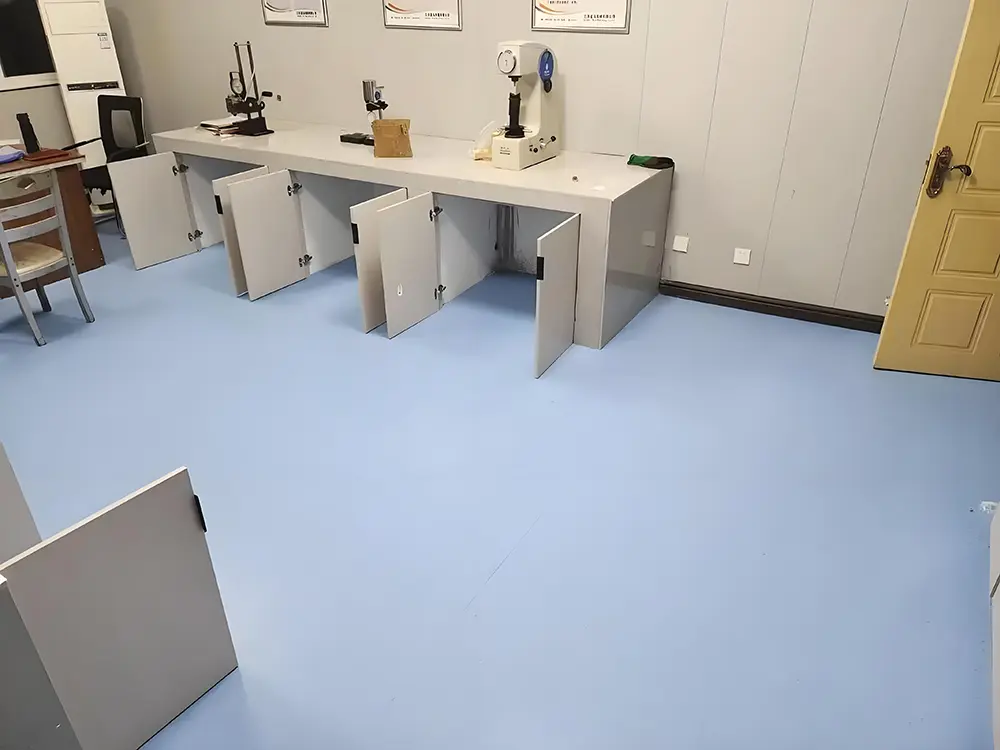
The waterproofness of commercial vinyl flooring is not due to a single surface process, but rather stems from "the inherent properties of the base material + structural design + sealing technology." This is what distinguishes it from solid wood and composite flooring, allowing it to adapt to humid environments.
Commercial vinyl flooring uses PVC as its core base material. Polyvinyl chloride itself is a non-porous, hydrophobic polymer material; water molecules cannot penetrate its molecular structure, fundamentally preventing the possibility of moisture intrusion. Unlike solid wood flooring (which easily absorbs water and swells) and composite flooring (whose substrate is prone to warping due to moisture), high-quality commercial vinyl flooring uses 100% virgin PVC resin, containing no hydrophilic components such as wood fibers. After high-temperature calendering, its density can reach 1.3-1.5 g/cm³, forming a dense waterproof barrier.
It is worth noting that there is a fundamental difference in waterproofness between commercial and residential products: commercial vinyl flooring contains special plasticizers and stabilizers, maintaining structural stability within a temperature range of -30℃ to 60℃, and its waterproof performance will not decrease due to temperature changes; while ordinary residential vinyl flooring may experience problems such as edge warping and seam cracking in long-term humid environments or with large temperature fluctuations.
In terms of structural design, different types of commercial vinyl flooring (rolls and sheets) have different structural focuses.
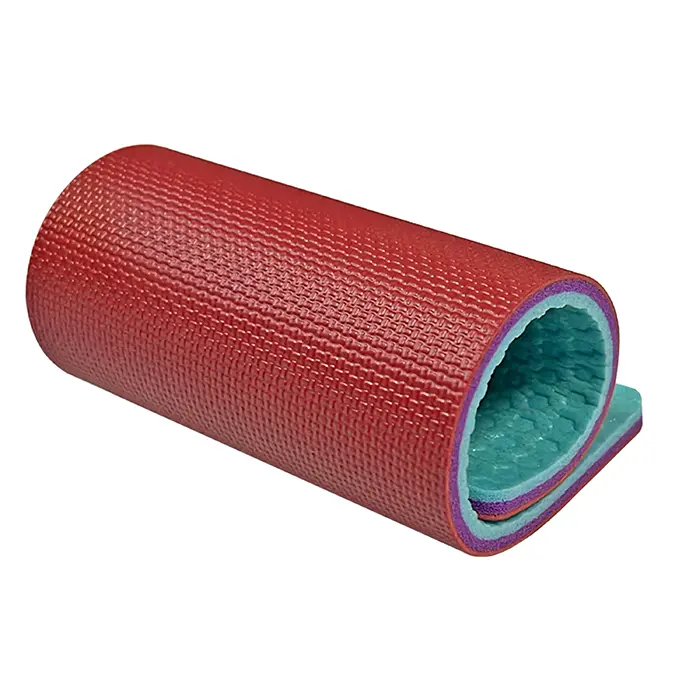
(1) Vinyl flooring rolls: These utilize a three-layer composite structure consisting of a wear-resistant surface layer, a PVC core layer, and a moisture-proof backing layer. Widths range from 1.8m to 2.0m, and lengths from 20m to 30m, allowing for seamless installation over large areas. The surface layer is a 0.3-0.7mm thick PUR wear-resistant coating, which not only enhances wear resistance but also prevents liquid penetration. The PVC core layer has a high-density, solid structure, free of pores and bubbles, preventing moisture residue. The backing layer is a PE moisture-proof membrane or PVC back coating, which prevents moisture from penetrating upwards from the ground, making it particularly suitable for ground-floor commercial spaces (such as underground shopping malls and basement dining areas).
(2) Vinyl sheet flooring: Common single-piece sizes are 300mm×300mm or 600mm×600mm. It employs a click-lock splicing design with a seam width ≤0.2mm. High-quality commercial sheet flooring employs a dual waterproofing process of "locking mechanism + sealant." Waterproof strips are built into the locking mechanism, forming a sealed, waterproof whole after splicing. Even if liquid is spilled, it will not seep into the base layer through the seams.
The waterproofing performance of commercial vinyl flooring must meet international standards (reference: ISO 2402-2017). The testing indicators and grading are as follows:
Test Methods:
① Immersion Test: Immerse the flooring sample in clean water at 23℃ for 24 hours and observe whether the sample shows dimensional changes (length and width change rate ≤0.5% is acceptable), surface wrinkling, delamination, etc.;
② Joint Waterproofing Test: Immerse the spliced flooring in water for 24 hours and observe whether there is water penetration at the seams and whether the base layer is damp;
③ Moisture Barrier Performance Test: Test the water vapor transmission rate of the backing moisture barrier membrane. ≤1.5g/(㎡·24h) is an excellent grade.
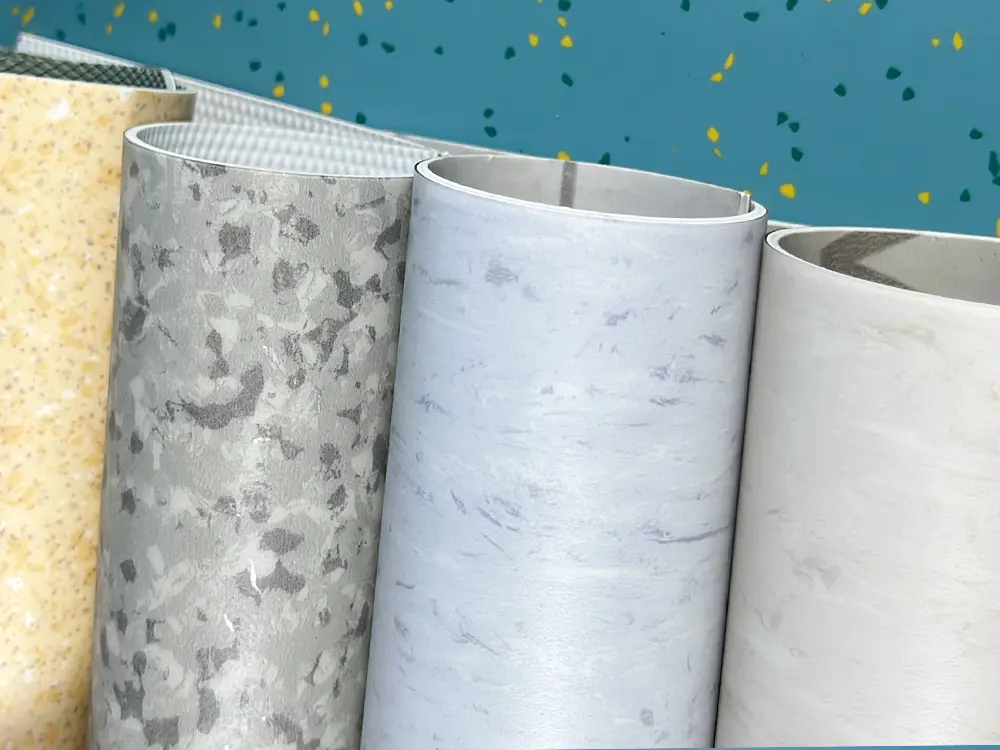
Anti-slip performance is a core guarantee of floor safety in commercial venues, especially in environments prone to water or oil stains such as restaurants, hospitals, and gyms, where slip resistance directly affects personnel safety.
Different anti-slip textures are designed for different scenarios, with mainstream patterns including:
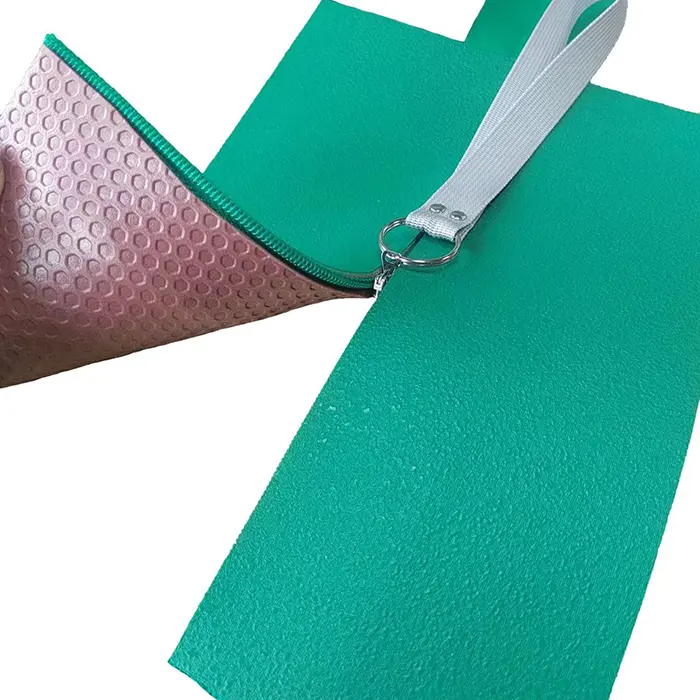
① Pixel Highlights: The surface features diamond-shaped raised areas, increasing the contact area between the shoe sole and the ground. The diamond-shaped grooves also quickly drain water, making it suitable for easily spilled environments such as restaurants and hospital corridors;
② Marble Imitation Texture: The surface features fine granular raised areas, resulting in a high coefficient of friction and stable anti-slip performance in both dry and wet conditions, suitable for high-end commercial areas such as shopping malls and public places;
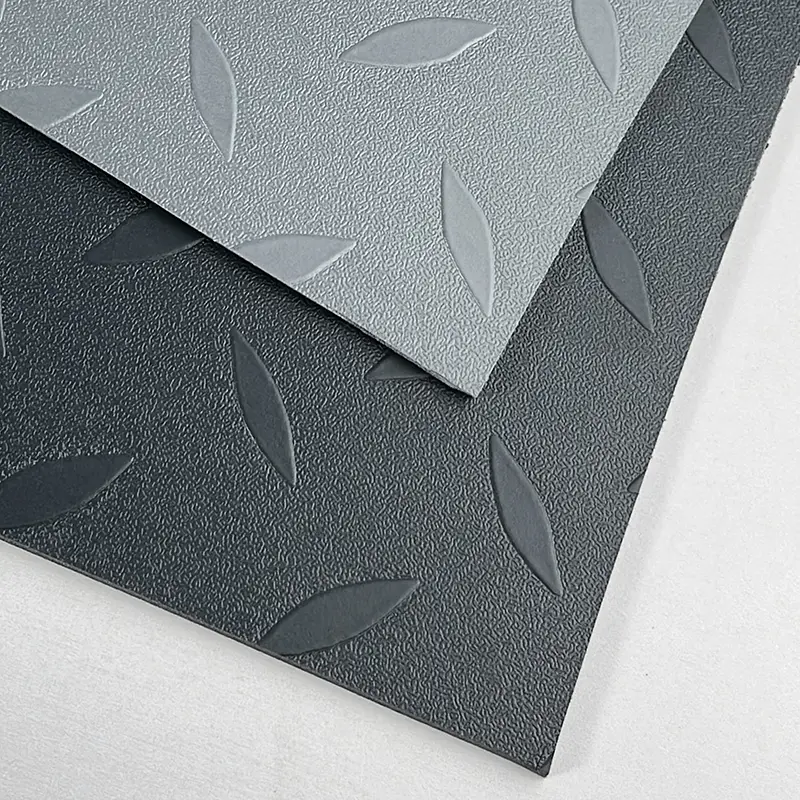
③ Single/Five-Leaf Texture: The surface features irregular leaf-shaped and granular distributions, suitable for high-traffic areas such as shopping malls, vehicle floors, airports, and subway platforms;
High-quality commercial vinyl flooring uses a PUR (polyurethane) wear-resistant coating with added nano-level anti-slip particles (such as alumina and silicon carbide), which not only improves wear resistance (Taber abrasion test reaches over 10,000 revolutions) but also enhances anti-slip performance. Some high-end products utilize a "dynamic anti-slip coating." In damp environments, a thin film of water forms on the coating surface, actually increasing friction and preventing slippage.
Prioritize 100% virgin PVC resin substrates, avoiding recycled materials (recycled materials are prone to porosity and reduced waterproofing). Make a preliminary judgment based on sample weight (for the same thickness, higher density means greater weight).
Confirm the surface wear-resistant coating is made of PUR material, with a thickness ≥ 0.3mm, and contains nano-anti-slip particles; the anti-slip texture should match the intended use, avoiding smooth, untextured products.
Splicing process: Roll products must support heat welding (joint strength ≥ 80% of substrate strength); sheet products must use a snap-lock + waterproof strip design to ensure seamless waterproofing after splicing.
Immerse samples in clean water for 24 hours, observing for delamination, wrinkling, and dimensional changes; place the spliced sample seam-side down on a damp towel for 24 hours, checking for dampness at the seams.
Spray water or cooking oil onto the sample surface, slide a rubber shoe sole across it to check for sufficient friction; gently scratch the surface with a coin or key to check if the anti-slip texture easily comes off.
In short, for commercial venue operators, choosing vinyl flooring with excellent waterproof and anti-slip properties not only reduces the risk of slips and floor damage, but also reduces subsequent cleaning and maintenance costs, and improves the safety and operational efficiency of the venue.

Leave Your Message
Message us for free samples and quotes!