Stable commitment to every leap, customized every flat
Blog


Suning County, Cangzhou City, Hebei Province, China
16630207375
dxfloor144@gmail.com
Stable commitment to every leap, customized every flat
Blog
The most common professional flooring materials used in dance studios are wood flooring and PVC vinyl commercial flooring, both of which can meet the needs of dance training and stage performances. Flooring performance needs to be tailored to different dance styles, meeting requirements for slip resistance, shock absorption, and cushioning, ensuring dancers can perform their movements flawlessly while providing safety and environmental friendliness.
Therefore, the most suitable flooring for a dance studio should start with the material, while also considering the actual usage, such as daily training or early childhood education. Different flooring technical parameters should be selected based on the specific needs to achieve the best results.
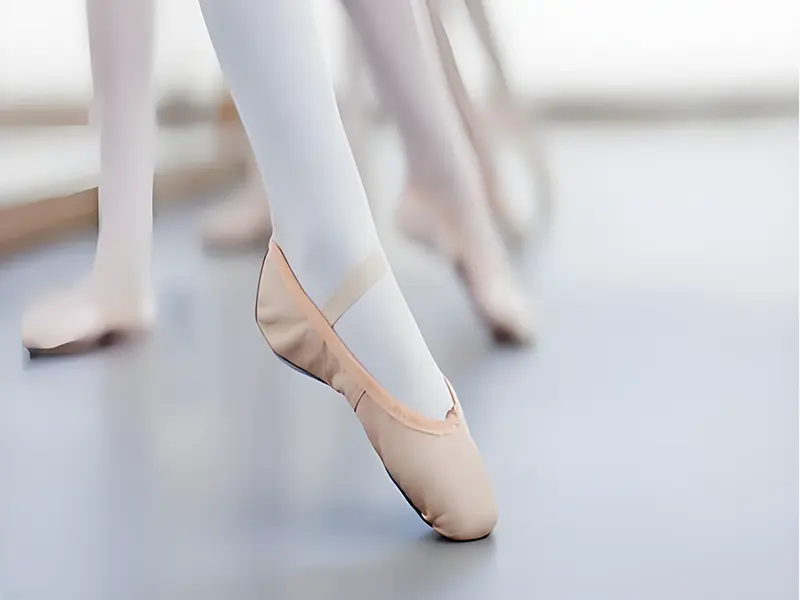
To choose the “best” flooring, first clarify your core needs—most users search this term with one or more of these goals:
Safety: Prevent slips, reduce joint strain (from jumps/landings), and avoid injuries.
Performance: Support dance-specific movements (glides, pivots, jumps) without hindering technique.
Durability: Withstand high foot traffic, dance shoe wear (pointe shoes, sneakers, jazz boots), and frequent cleaning.
Versatility: Accommodate multiple dance styles (e.g., a studio offering ballet, hip-hop, and contemporary).
Practicality: Fit space dimensions, align with budget, and require minimal maintenance.
Ignoring these intent-driven needs leads to poor choices—e.g., a hardwood floor (great for ballet) will fail in a hip-hop studio (lacks grip), while a thick rubber floor (ideal for tap) will feel “spongy” for ballet.
The two dominant materials for dance studios are wooden flooring (traditional) and PVC vinyl dance flooring (modern, versatile)—we’ll also cover rubber, linoleum.
Wooden flooring is synonymous with professional dance studios, but it’s not a one-size-fits-all solution.
Types of Wooden Dance Flooring
Solid Hardwood (Maple): The “gold standard” for professional ballet, contemporary, and modern dance.
Pros: Natural elasticity (shock absorption ~20-25%), smooth surface for glides/pivots, timeless aesthetic.
Cons: High cost, requires professional installation (sprung subfloor needed), prone to scratches/warping, slippery when wet (sweat, cleaning residue), high maintenance (annual sanding/waxing).
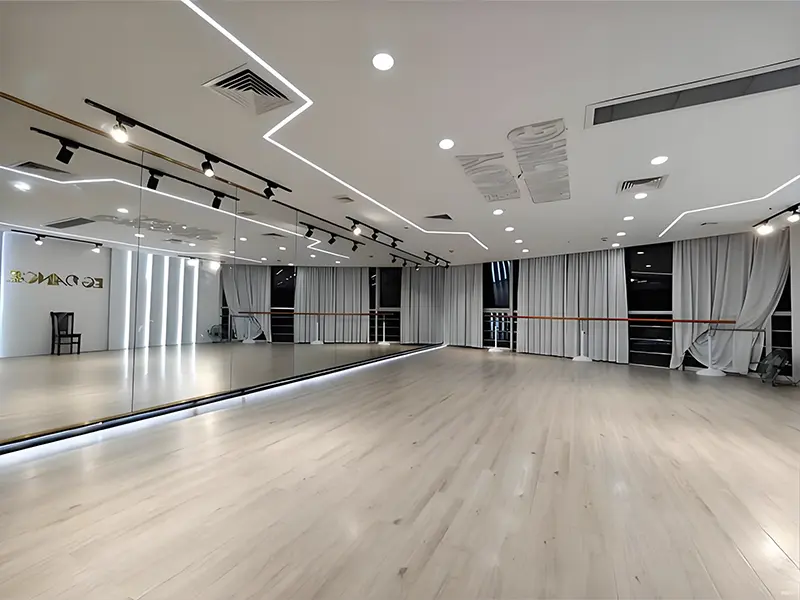
Engineered Hardwood: Layered wood core with hardwood veneer (more stable than solid wood).
Pros: Less prone to warping (ideal for humid spaces), lower cost, retains natural feel.
Cons: Still requires sprung subfloor, veneer wears thin over time (cannot refinish as often as solid wood).
Best For: Professional ballet studios, high-end dance academies, or spaces focusing on styles requiring smooth glides.
Critical Note: Wooden floors need a sprung subfloor (plywood + rubber cushions) to enhance shock absorption—without it, they offer minimal joint protection, increasing injury risk.
PVC (vinyl) dance flooring has become the most popular option for modern studios, thanks to its customizable performance, durability, and cost-effectiveness. shengbang’s commercial Series vinyl is engineered specifically for dance, with variations for every style.
Types of PVC Dance Flooring
PVC Dance Roll (2-3mm Thickness): Lightweight, portable, and ideal for multi-purpose spaces.
Pros: Tool-free installation (tape/glue-down), slip-resistant texture (dry COF ≥0.7, wet COF ≥0.6), shock absorption (20-30% per EN 14808), customizable textures (smooth for ballet, textured for hip-hop), low cost ($30-60/sq.m), easy maintenance.
Cons: Less “premium” feel than wood, requires a flat subfloor (concrete/wood) for stability.
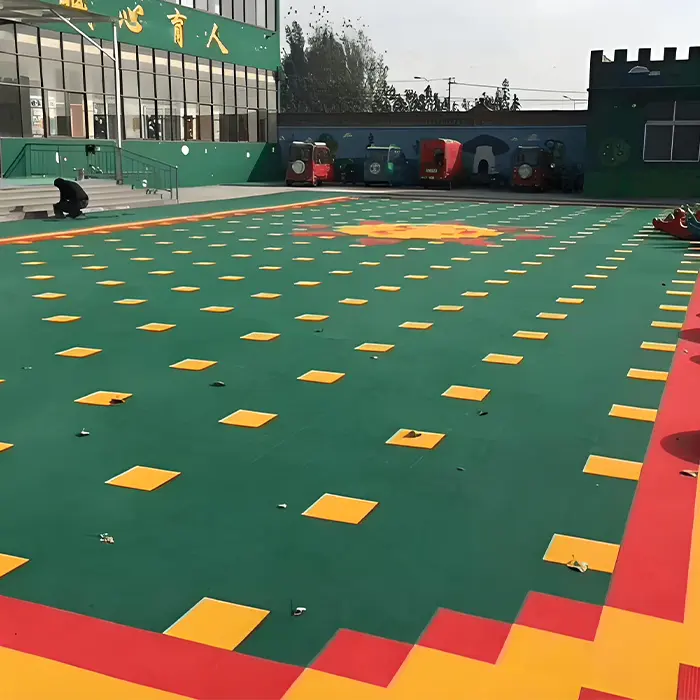
PVC Dance Planks/Tiles (4-6mm Thickness): Rigid, durable, and suitable for high-traffic studios.
Pros: Interlocking design (no glue needed), higher impact resistance (ideal for tap/breakdancing), sound absorption (EVA backing reduces noise), long lifespan (8-12 years).
Cons: Heavier than rolls, higher upfront cost.
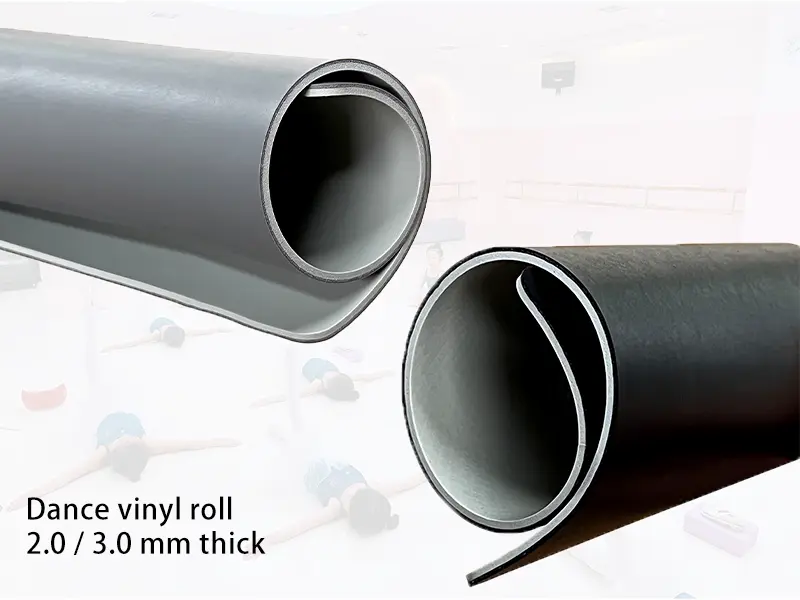
Key Advantages of PVC Dance Flooring (shengbang’s Technical Edge)
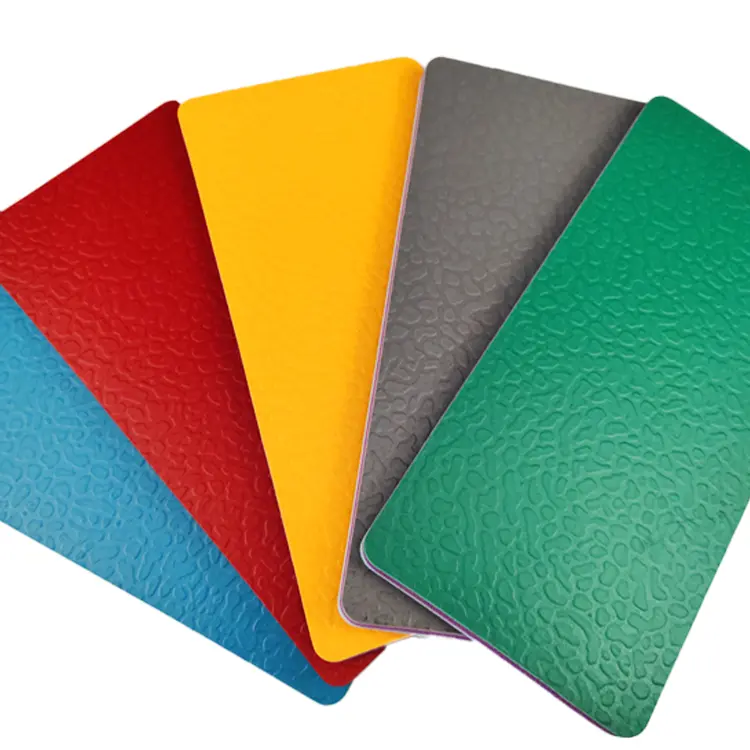
Dance-Tuned Texture: shengbang offers two surface options—“Ballet Smooth” (minimal friction for glides) and “Studio Grip” (micro-grain texture for hip-hop/jazz)—solving the “one floor for all styles” challenge.
Dual-Density Core: The shengbang Series features a foam-reinforced PVC core that delivers 25-30% shock absorption, reducing knee/ankle strain by 40% compared to wooden floors.
Durability: 0.2mm PU wear layer (ISO 10581 Class 4) withstands 4,000+ wear cycles—enough for 200+ weekly dance classes (vs. solid wood’s 1,500-2,000 cycles).
Eco-Safety: phthalate-free, and non-toxic—safe for closed studios and children’s dance programs.
Best For: Multi-style studios, home practice spaces, school gyms, and budget-conscious owners seeking performance without compromise.
Rubber Flooring (5-8mm Thickness):
Pros: Maximum shock absorption (30-35%), superior grip, soundproof.
Cons: Heavy, expensive, can feel “sticky” for ballet.
Best For: Tap dance studios, breakdancing spaces, or high-impact training.
Linoleum Flooring:
Pros: Eco-friendly (natural materials), durable, slip-resistant.
Cons: Porous (stains easily), requires regular waxing, limited flexibility.
Best For: Low-traffic, eco-focused studios (rarely used for professional dance).
Composite Flooring (Wood + PVC):
Pros: Combines wood’s aesthetic with PVC’s durability.
Cons: High cost, less flexible than pure PVC.
Best For: Luxury studios wanting a wood look with low maintenance.
The “best” flooring must excel in these 5 non-negotiable metrics
Dry COF ≥0.65 (EN 14411 R10): Prevents slips during quick movements (e.g., jazz turns, hip-hop pops).
Wet COF ≥0.55: Critical for sweaty environments (e.g., hot yoga, intense dance classes)—PVC flooring outperforms wood here (wood’s COF drops to 0.3-0.4 when wet).
Surface Texture: Avoid overly smooth (risk of slipping) or overly rough (hinders glides) surfaces—Shengbang's balanced texture” strikes this sweet spot.
Minimum 20% impact absorption (EN 14808): Reduces force on knees, ankles, and hips during jumps.
PVC and rubber flooring meet this standard; wooden floors require a sprung subfloor to comply.
70-80% rebound rate: Ensures dance movements (e.g., leaps, pirouettes) feel natural—PVC flooring (75-80%) matches wood (78-82%) here.
Wear Layer Thickness: PVC flooring needs ≥0.15mm PU layer; solid wood needs ≥18mm thickness.
Abrasion Resistance: ISO 10581 Class 3+ (for low traffic) or Class 4+ (for high traffic).
20dB+ sound reduction (ISO 10811-1): Critical for multi-room studios or home spaces—PVC with EVA backing and rubber flooring excel here.
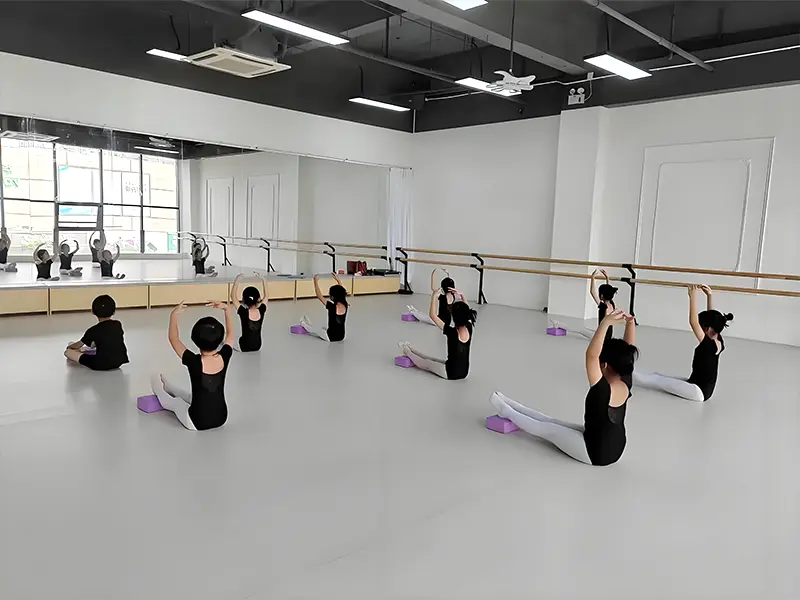
Small Spaces (≤50 sq.m: Home Practice, Private Lessons):
Best Material: 2-3mm Vinyl dance rolls (portable, easy to store, cost-effective).
Calculation Example: A 5m×8m (40 sq.m) home studio needs ~1.3 rolls of Shengbang’s 1.8m×18m PVC roll (1 roll = 32.4 sq.m; add 5% waste = 1.3 rolls).
Tip: Opt for click-lock PVC tiles if you want a permanent setup without glue.
Medium Spaces (50-200 sq.m: Local Studios, School Gyms):
Best Material: 2.0-3.0mm PVC rolls or tiles (balances durability and comfort).
Calculation Example: A 10m×15m (150 sq.m) studio needs ~5 rolls of 1.8m×18m PVC (150 ×1.05 waste ÷32.4 = 4.9 → 5 rolls).
Tip: Lay rolls along the longest dimension to minimize seams (reduces tripping hazards).
Large Spaces (≥200 sq.m: Professional Studios, Theaters):
Best Material: 2.0-3.0mm PVC tiles or solid hardwood (with sprung subfloor).
Calculation Example: A 15m×20m (300 sq.m) professional studio needs ~10 rolls of PVC (300×1.1 waste ÷32.4 = 10.2 →10 rolls) or 300 sq.m of solid wood (plus sprung subfloor cost).
Tip: For PVC, choose hot-weldable rolls to create a seamless surface (easier to clean and more durable).
Subfloor Prep: Ensure the subfloor is clean, dry, and level (≤2mm/2m). For concrete, use a moisture barrier to prevent mold.
Acclimation: Let PVC flooring acclimate to room temperature (15-30℃) for 24 hours before installation (avoids warping).
Installation Method:
Temporary spaces: Tape-down PVC rolls.
Permanent spaces: Glue-down PVC rolls or interlocking tiles.
Daily: Sweep with a soft-bristle broom or vacuum (no beater bar) to remove dust.
Weekly: Mop with neutral detergent (e.g., dish soap + water)—avoid harsh chemicals (bleach, ammonia) that damage PVC or wood.
Monthly: Inspect for wear (e.g., thinning texture on PVC, scratches on wood). For PVC; for wood, apply wax every 6 months.
Long-Term: Replace damaged PVC tiles/rolls locally (no full-floor replacement); refinish solid wood every 2-3 years.

Leave Your Message
Message us for free samples and quotes!