Stable commitment to every leap, customized every flat
Blog


Suning County, Cangzhou City, Hebei Province, China
16630207375
dxfloor144@gmail.com

Stable commitment to every leap, customized every flat
Blog
Industrial production, warehousing, logistics, and manufacturing processes demand flooring materials with requirements far exceeding those of sports flooring and commercial vinyl flooring. These facilities require floors to withstand heavy forklift traffic, chemical spills, and frequent foot traffic, while also ensuring slip resistance, ease of cleaning and maintenance, and long-term durability. In production workshops filled with equipment, anti-static properties are often required; otherwise, static electricity can easily lead to dust explosions and short circuits. Therefore, the flooring must possess these functionalities.
To this end, for Industrial Vinyl flooring, we provide reliable industrial flooring material solutions for users through customized material formulations and reinforced structural designs.
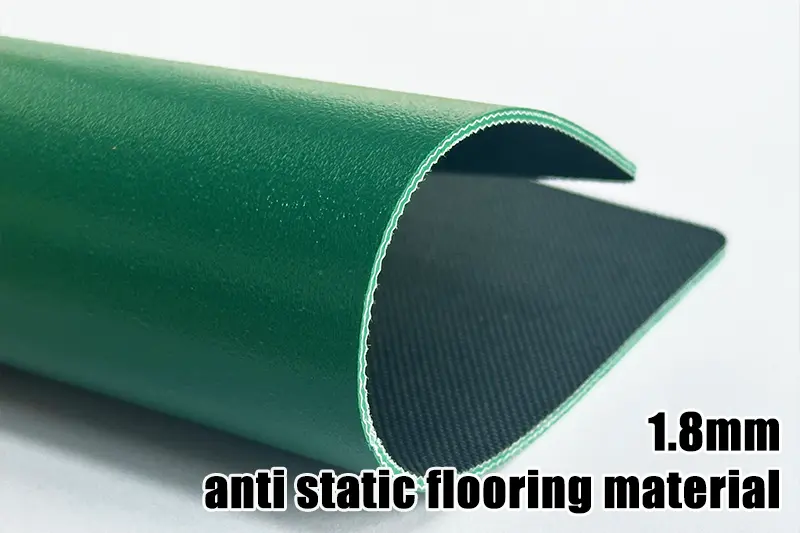
Designed for the electrostatic protection needs of electronics factories, semiconductor workshops, and precision instrument processing plants, this is a mandatory material for electronic industry flooring.
Carbon black and conductive fibers are added to the PVC substrate to form a three-level conductive system: an antistatic surface layer, a conductive base layer, and a grounding layer. The surface resistance can be precisely controlled between 10⁶ and 10⁹ Ω.
Permanent antistatic properties (non-coating type, maintaining performance even after wear) are achieved, along with oil resistance and easy cleaning, preventing static electricity from attracting dust and affecting precision production.
Suitable for installation in chip manufacturing workshops, mobile phone assembly lines, precision instrument warehouses, and laboratory production areas.
Suitable for chemical workshops, food processing plants, and pharmaceutical production workshops, addressing issues such as chemical leaks, acid and alkali corrosion, and food residue contamination.
Uses a chemically modified PVC substrate with a PUR chemical-resistant sealant layer. Seamlessly heat-welded, with zero porosity, it completely prevents liquid penetration.
Resistant to long-term corrosion from acids, alkalis, organic solvents, and food-grade acidic and alkaline solutions. Odorless, does not breed bacteria, and can withstand high-temperature, high-pressure cleaning.
Suitable for installation in chemical raw material production workshops, beverage processing plants, meat slaughtering and processing areas, pharmaceutical preparation workshops, etc.
Specifically designed for heavy manufacturing workshops, large-scale logistics warehouses, and port cargo terminals, this is the strongest category of industrial vinyl flooring in terms of load-bearing and wear resistance.
It features a "thickened wear layer + high-density PVC base layer + fiberglass stabilization layer + anti-crush backing layer," with the wear layer enhanced with silicon carbide wear-resistant particles and a base layer density of ≥1.8 g/cm³.
It can withstand long-term crushing by heavy forklifts over 10 tons, offers excellent impact resistance, can withstand the impact of falling metal workpieces, and the seamless heat welding process eliminates the risk of forklift tires getting stuck in seams.
Suitable for installation in automobile manufacturing workshops, heavy machinery processing plants, large-scale storage centers, and container sorting areas.
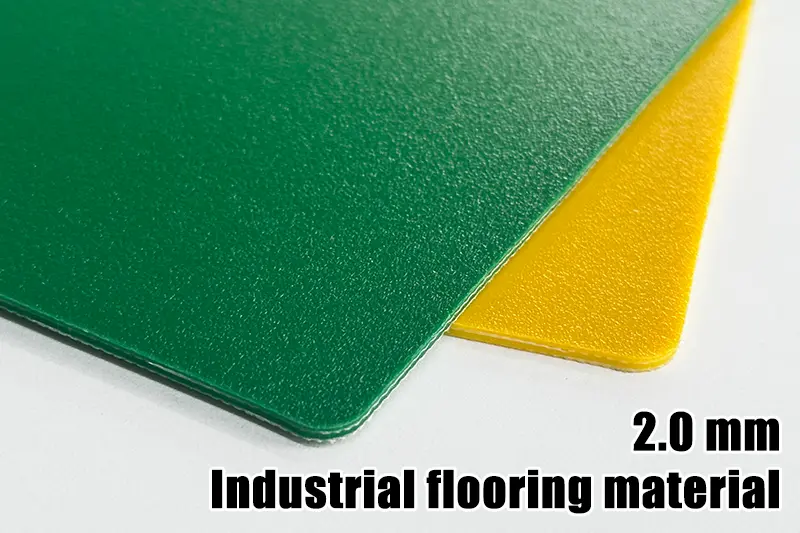
Industrial Vinyl flooring's base material undergoes high-pressure compaction treatment, combined with a reinforced interlocking/thermal welding structure, allowing it to withstand long-term pressure from light-duty manual forklifts, heavy-duty electric forklifts, and AGVs (Automated Guided Vehicles) without cracking, denting, or warping.
In industrial production, falling metal workpieces, dragging tools, and frequent foot traffic are common occurrences. Industrial Vinyl flooring's thickened wear-resistant layer and high-density base material resist various physical losses.
Safety hazards in industrial settings mainly stem from slipping, static electricity, and tripping. Industrial-grade anti-slip textures quickly discharge static electricity, and the roll material features seamless thermal welding.
Chemical, food, and pharmaceutical environments have extremely high requirements for floor corrosion resistance and cleanliness. Industrial Vinyl flooring's seamless structure and chemical-resistant surface completely prevent liquid penetration.
Industrial workshops often experience extreme environments such as high-temperature baking (e.g., automotive paint booths) and low-temperature refrigeration (e.g., food cold storage). Industrial Vinyl flooring can withstand temperature variations from -30℃ to 80℃, and with the addition of a fiberglass stabilizing layer, its dimensional shrinkage rate is ≤0.3%.
Find vinyl flooring materials that meet the specific needs of your workshop.
Heavy-duty manufacturing workshops: High load-bearing capacity, impact resistance, and wear resistance
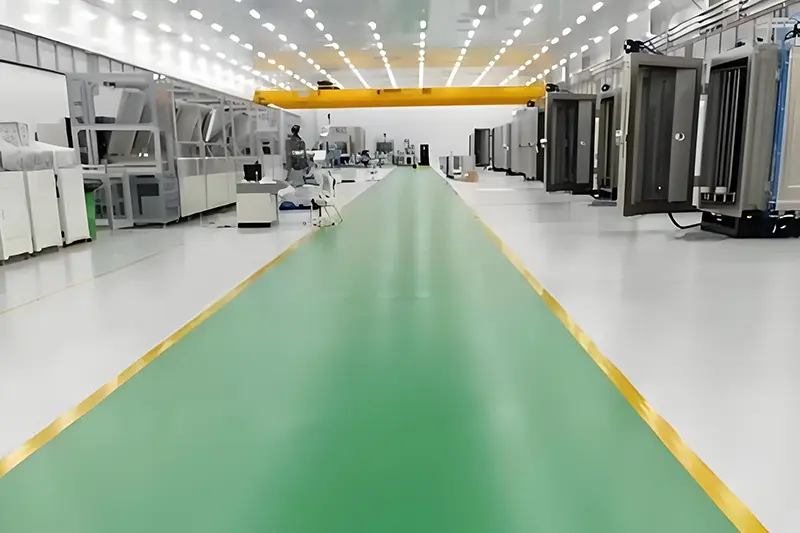
Electronic precision workshops: Anti-static, dustproof, and easy to clean
Food processing plants: Food-grade safety, acid and alkali resistance, and antibacterial properties
Small and medium-sized warehouses: Quick installation, low cost, and easy maintenance
Chemical workshops: Strong resistance to chemical corrosion and leak-proof
Cold storage workshops: Low-temperature resistance, slip resistance, and freeze-cracking resistance
Substituting civilian-grade Vinyl flooring for industrial-grade: Civilian-grade flooring lacks sufficient load-bearing capacity and wear resistance, and will be damaged by forklifts within 1-2 months;
Ignoring seamless construction: Seamed flooring is prone to oil and chemical penetration, leading to mold and corrosion. Industrial settings must prioritize heat-welded seamless rolls or high-precision interlocking sheets;
Focusing solely on price without considering certifications: Industrial Vinyl flooring must have ISO 9001 quality certification and relevant industry-specific certifications (such as FDA certification for food factories and anti-static certification for electronics factories). Products without certification pose safety and quality risks.
Industrial bases are mostly concrete, requiring no complex renovations before installation.
After delivery, the flooring should be left to stand in the workshop environment for 24 hours to acclimatize to the temperature and humidity of the industrial site, preventing future deformation.
Industrial-grade PVC adhesive is used for bonding, and seams are welded using a hot air welding machine (weld strength ≥ substrate strength).
Acceptance standards: No gaps, no warping, no shaking under forklift loads, and the anti-static version meets grounding resistance test standards.
Daily removal of dust and metal debris using an industrial sweeper; weekly cleaning with a floor scrubber and neutral detergent; oil stains wiped directly with industrial degreaser.
Apply industrial-grade PVC curing agent to the roll flooring every 6-12 months to enhance the wear-resistant layer; monthly check the connection of the click-locking sheets and secure any loose parts promptly; wipe up chemical spills immediately to prevent long-term corrosion; anti-slip mats can be laid in areas where heavy equipment is placed for further protection.
Yes. Heavy-duty industrial vinyl flooring, with its high-density substrate and thickened wear-resistant layer, can withstand the long-term rolling pressure of a 10-15 ton forklift.
Yes. This chemically resistant industrial vinyl flooring, specifically designed for food factories, is formaldehyde-free, heavy metal-free, and has a seamless surface that prevents bacterial growth.
Superior overall performance. Epoxy flooring is prone to peeling and cracking under forklift pressure, has weak chemical corrosion resistance, and high maintenance costs; while industrial vinyl flooring is stronger, more wear-resistant, durable, has a seamless structure to prevent leakage, and is easy to maintain.
Permanently effective. The antistatic performance of industrial antistatic vinyl flooring is achieved by adding conductive additives to the substrate, making it "material-level antistatic," not coating-based antistatic (which fails after coating wear).
Yes. If the old epoxy flooring does not have large areas of peeling or flaking, it only needs to be sanded smooth and oil stains removed before directly laying click-lock industrial Vinyl sheets.


Leave Your Message
Message us for free samples and quotes!