Stable commitment to every leap, customized every flat
Blog


Suning County, Cangzhou City, Hebei Province, China
16630207375
dxfloor144@gmail.com
Stable commitment to every leap, customized every flat
Blog
Indoor volleyball is a team sport, unlike badminton or pickleball, with more players on each side and a larger court. It demands high levels of precision, agility, and safety – all of which depend on the quality of the court surface. PVC vinyl sports flooring is a good choice because it balances performance and cost. In this article, we'll explore why PVC flooring is the best choice for indoor volleyball courts, analyze its key performance indicators, and share our advice from decades of experience as a manufacturer on selection and maintenance to help you make an informed decision.
For any indoor sports flooring, the most important factor is its shock absorption capacity, which reduces the risk of joint injuries (knees, ankles, hips) for athletes. PVC volleyball flooring uses a multi-layered structure – typically including foam padding or an integrated cushioning layer – capable of absorbing 30% to 50% of the impact force from jumps and landings, far exceeding concrete or even hardwood floors. This shock absorption not only protects athletes from acute injuries but also minimizes long-term wear and tear on the body, making it ideal for high-frequency training and competitive matches. The International Volleyball Federation (FIVB) standards require indoor volleyball courts to have a vertical shock absorption rate of 40% to 60%, and high-quality PVC flooring easily meets or even exceeds this standard.
Volleyball players need fast, precise movements—such as dives, spikes, and lateral movements—which require a court surface with stable grip. PVC flooring features special anti-slip textures (such as jewel or pebbled patterns) that provide excellent grip even when wet with sweat, preventing slips without restricting movement. Unlike rubber flooring, which can feel sticky or sluggish, PVC flooring offers a balanced coefficient of friction (typically 0.6 to 0.8 on dry surfaces and 0.5 to 0.7 on wet surfaces), ensuring players can move freely while maintaining control. This balance is crucial: too much grip can lead to knee strains, while too little grip increases the risk of injury.
Indoor volleyball courts—whether used for professional competitions, school training, or recreational purposes—face the challenges of high traffic, equipment impact, and frequent cleaning. PVC flooring is designed to withstand this wear and tear, with its abrasion layer (0.3 to 0.7 mm thick) effectively resisting scratches, abrasions, and damage from volleyballs, shoes, and training equipment. High-quality PVC flooring boasts an abrasion rating exceeding 80,000 revolutions and, with proper maintenance, a lifespan of 8 to 12 years—two to three times that of traditional wood flooring. Furthermore, it resists UV fading and detergent discoloration, maintaining its appearance even after years of intensive use.
Evening managers prioritize easy-to-maintain flooring, and PVC flooring excels in this regard. Unlike solid wood flooring, which requires regular sanding, refinishing, and humidity control, PVC flooring can be easily cleaned with a damp mop and mild detergent—sweat, dirt, and spills can be wiped away in minutes without leaving a trace. It requires no waxing, polishing, or special treatment, so its annual maintenance cost is about one-third that of solid wood flooring. Furthermore, PVC flooring has a lower upfront cost compared to professional solid wood or rubber flooring, making it an economical choice for large venues and smaller facilities.
PVC flooring is versatile and adaptable to different court sizes (standard indoor volleyball court is 9m x 18m) and layouts. It is supplied in rolls (1.8m or 2.0m wide) and can be cut to fit any space, minimizing seams and reducing tripping risks. Many PVC flooring products come pre-printed with high-contrast court lines (service lines, attack lines, boundary lines), eliminating the need for manual painting and ensuring compliance with FIVB standards. In addition, it is available in a variety of colors (blue, green, etc.).
Customization is possible based on venue branding or design preferences without compromising performance.
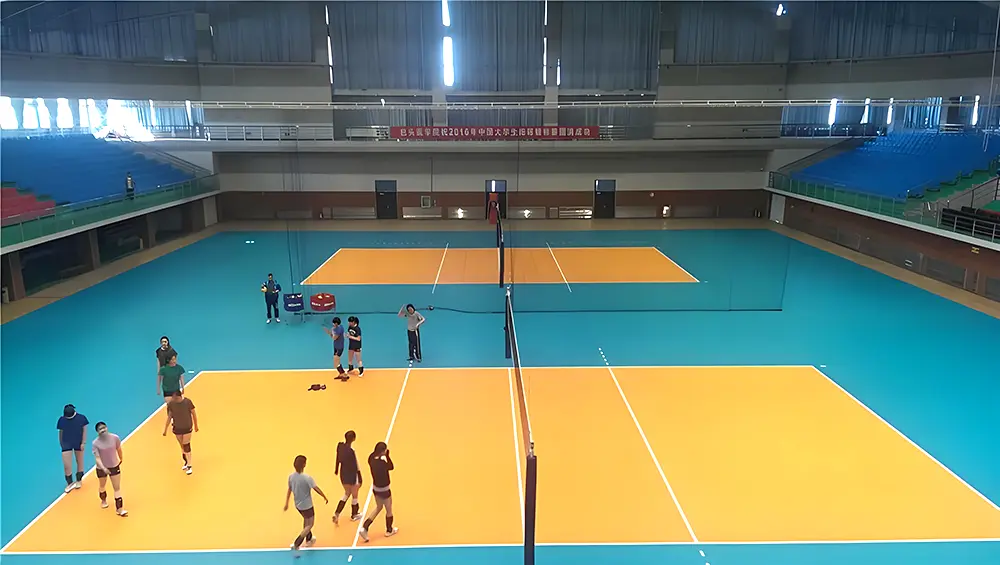
Not all PVC flooring is created equal—when choosing the best option for your indoor volleyball court, focus on the following key performance indicators to ensure it meets professional standards and athlete needs:
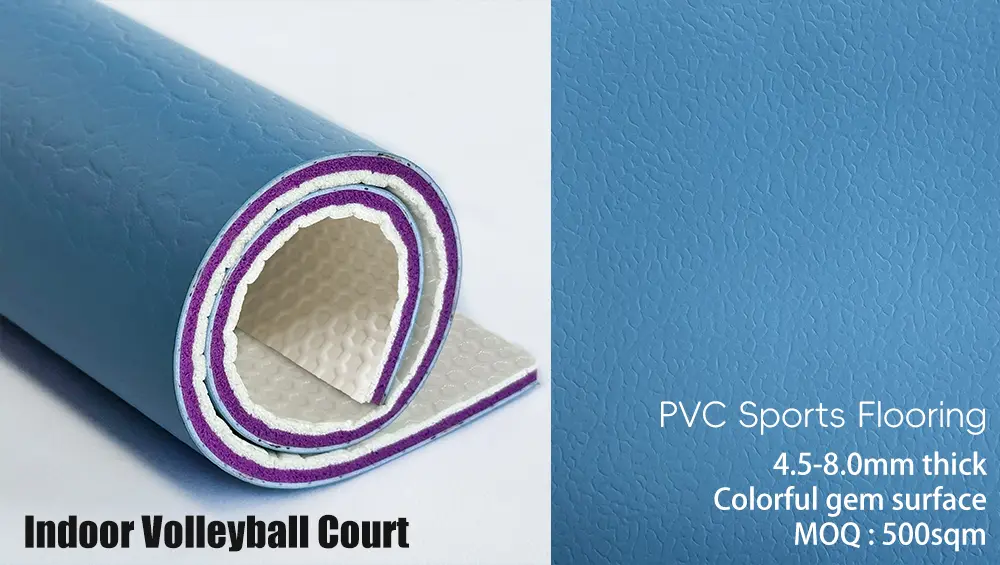
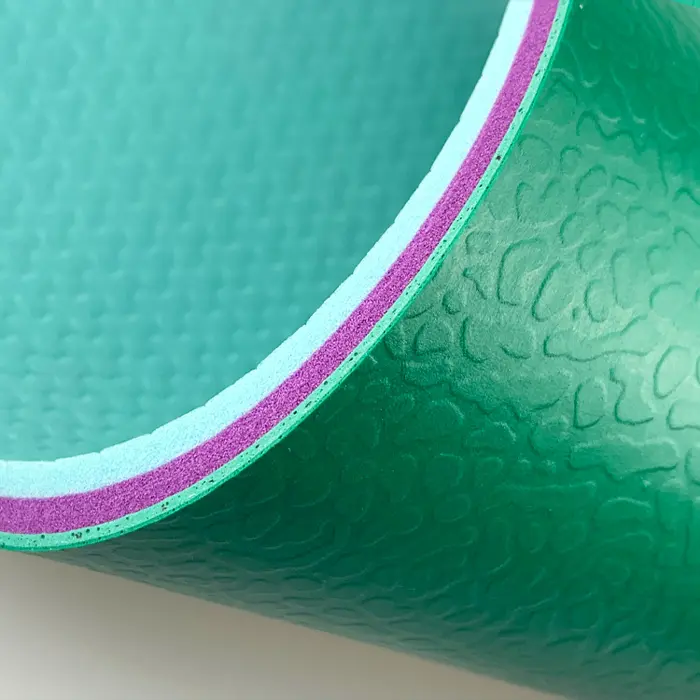
The ideal thickness for indoor volleyball court PVC flooring is 4.5 mm to 8.0 mm. This thickness balances cushioning and stability: thinner floors (3.0-4.0 mm) lack sufficient shock absorption, while thicker floors (10.0 mm and above) may feel unstable during rapid movements. The best PVC flooring uses a multi-layered structure: a wear layer, a fiberglass layer, a foam cushioning layer, etc. Fiberglass reinforcement is particularly important as it prevents the flooring from expanding or contracting due to temperature changes; choosing double-layer fiberglass ensures stable performance.
As mentioned earlier, the International Volleyball Federation (FIVB) requires a vertical shock absorption rate of 40% to 60%. Choose PVC flooring with a shock absorption rate of at least 45% to ensure optimal protection for athletes. In addition, the elastic recovery rate (the floor's ability to return to its original shape after impact) should be 95% or higher—this ensures bounce stability and prevents surface unevenness from affecting the ball's trajectory and the athlete's movement.
The slip resistance of flooring is measured by the coefficient of friction (COF). For indoor volleyball, the ideal COF is 0.6 to 0.8 in dry conditions and 0.5 to 0.7 in wet conditions. Choose textured (rather than smooth) flooring to enhance grip and ensure it meets the slip resistance requirements of EN 14411 (European standard) or ASTM F1677 (American standard).
High-quality PVC flooring should be free of harmful chemicals such as formaldehyde, heavy metals, and phthalates, and meet international environmental standards. Choose products with certifications such as SGS, CE, ISO 9001, or Cradle to Cradle to ensure the flooring is safe for athletes and the environment. Low VOC (volatile organic compound) emission certification is especially important for venues hosting children's or youth activities.
Choosing the right PVC flooring requires balancing your venue's needs, budget, and frequency of use. Follow these expert tips to make the best choice:
First, determine the purpose of your venue: professional competition, high-intensity training, school physical education classes, or recreational play. Professional and high-intensity training venues should invest in high-quality PVC flooring (4.5-6.0 mm thick, fiberglass reinforced, FIVB certified) to ensure optimal durability and athlete protection. Recreational or school venues can opt for medium-thickness flooring (4.0-4.5 mm thick) to balance performance and cost. Avoid using inferior PVC flooring (less than 4.0 mm thick) as it wears out quickly and increases the risk of injury.
Excellent PVC flooring brands specialize in sports venues and have a proven track record of meeting international standards. You can refer to brands such as Dongxing Sports, Gerflor, Tarkett, etc., which offer reliable performance and are certified high-quality manufacturers.
Even the best PVC flooring can suffer performance issues if improperly installed. Ensure the subfloor is clean, level, and dry (moisture content ≤3%) – any unevenness or dampness can cause the flooring to warp, blister, or peel over time. Hire experienced professional sports PVC flooring installers who can ensure the flooring adheres fully to the subfloor, seams are securely welded, and court lines are aligned. Avoid DIY installation, as errors (such as improper glue application or insufficient drying time) can void the warranty and shorten the flooring's lifespan.
If your venue has unique branding or design requirements, choose PVC flooring with customizable colors, logos, or court line configurations. Many manufacturers can print custom court lines that meet FIVB standards or add venue logos to enhance branding. Additionally, consider using matte flooring to reduce glare, which is especially important for brightly lit indoor courts.
1. Substrate Preparation: Clean the substrate (concrete or wood) to remove dirt, dust, and debris. Repair any cracks or uneven areas with epoxy mortar and ensure the substrate is level (maximum unevenness of 2 mm per 2 meters). For concrete substrate, use the plastic film test to check humidity (seal 1 square meter of plastic film on the floor for 24 hours—if there is no condensation, the floor is sufficiently dry).
2. Acclimatization: Acclimate the PVC flooring rolls in an indoor environment for 24-48 hours before installation. This prevents expansion or contraction after installation.
3. Adhesion and Seams: Use a high-quality adhesive specifically designed for sports PVC flooring and apply it evenly to the substrate. Roll the flooring into place and use a 50-70 kg steel roller to ensure a strong bond and remove air bubbles. Weld the seams 24-48 hours after installation (after the adhesive has dried) to prevent moisture from seeping beneath the floor.
1. Daily Cleaning: Sweep or vacuum the floor to remove dust and debris. Mop with a damp mop and a mild, neutral detergent (avoid using harsh chemicals such as bleach or ammonia, as these can damage the wear layer).
2. Weekly Maintenance: Deep clean the floor with a floor scrubber to remove stubborn stains or sweat. Rinse with clean water and dry with a microfiber mop to prevent slipping.
3. Long-Term Maintenance: Regularly inspect the floor for cracks, seam widening, or signs of wear. Repair small damage promptly (using a repair kit) to prevent it from spreading. Every 3-5 years, apply a protective coating to the wear layer to extend its lifespan.
4. Avoid Damage: Do not place sharp objects (such as shoe nails, scissors, or tools with sharp edges) on the floor, as they may scratch or puncture the wear layer. Use furniture pads under all equipment (such as benches and nets) to prevent dents.
Many venue managers make costly mistakes when choosing PVC flooring—here are some of the most common mistakes to avoid:
1. Choosing the wrong thickness: Choosing flooring that is too thin (below 4.0 mm) reduces shock absorption, while choosing flooring that is too thick (above 6.0 mm) reduces stability. Indoor volleyball court flooring thickness should be between 4.0 and 6.0 mm.
2. Prioritizing price over quality: Low-priced PVC flooring often lacks fiberglass reinforcement, has a thin abrasion layer, and does not meet FIVB standards. Such flooring wears out quickly and requires expensive replacements.
3. Neglecting subfloor preparation: Even with high-quality flooring, improper subfloor preparation (uneven, damp, or dirty) can lead to warping, bubbling, or peeling.
4. Skipping professional installation: DIY installation often results in weak adhesion, uneven seams, and misaligned court lines, all of which affect court performance and void the warranty.

Leave Your Message
Message us for free samples and quotes!