Stable commitment to every leap, customized every flat
Blog


Suning County, Cangzhou City, Hebei Province, China
16630207375
dxfloor144@gmail.com
Stable commitment to every leap, customized every flat
Blog
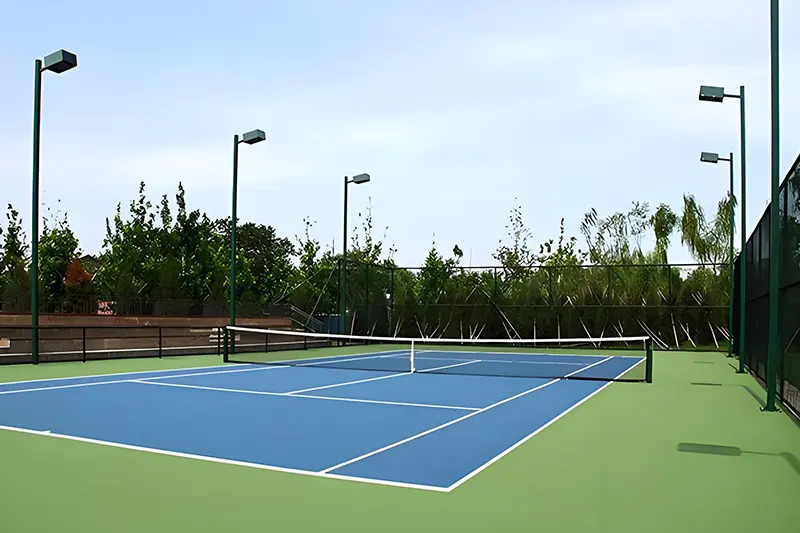
Tennis demands high standards for court surface performance, including ball bounce stability, slip resistance, weather resistance, and cushioning. Therefore, court flooring materials must meet the most authoritative international ITF standards. Only tennis court flooring materials certified by this standard can meet the requirements of both the court and the players. This is crucial for the construction of both indoor and outdoor tennis courts. This article will provide a detailed explanation of ITF indicators and the types of flooring materials that meet these requirements. This is essential knowledge for your procurement and acceptance process.
Ball Rebound Rate (COR) ≥ 85% (Professional Training/Tournament Grade ≥ 88%), Overall Rebound Consistency Error ≤ 5%.
Test Method: A tennis ball is dropped freely from a height of 2.54m, and the rebound height ratio is compared to that of a rigid surface.
Impact Absorption: 15%~20% (International Tournament); 10%~15% (Professional Training).
Function: Absorbs the impact force of player landings, protecting joints.
Coefficient of friction (COF): Dry state 0.60~0.75, wet state ≥0.55, overall friction uniformity deviation ≤0.05.
Function: Balances grip and sliding, preventing slippage or jamming.
Vertical deformation within 2.0~3.0mm, deformation recovery rate ≥95%.
Function: Controls floor elastic deformation, ensuring stable foot feel.
Rolling load ≥1500N, no cracking, denting, or warping after testing.
Function: Resists the pressure of court equipment, preventing floor damage.
Field flatness error ≤2mm, measured with a 3m straightedge, no local bumps/dents.
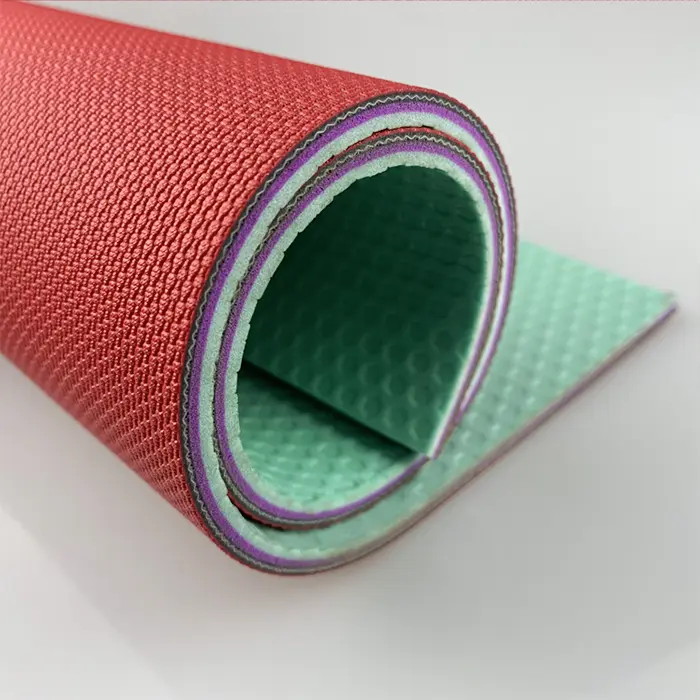
PVC tennis court flooring offers a cost-effective option, eliminating the high price and maintenance costs of turf and wood flooring. It is also easy to install and can even be used for multiple purposes. With the addition of fiberglass layers, foamed cushioning layers, and wear-resistant layers, and treated with special TPU technology, it possesses excellent athletic performance and practicality, making it the mainstream material for indoor tennis courts and professional training halls. It is widely used in schools, commercial clubs, and indoor sports courts.
Indoor pvc tennis court flooring roll (grass surface and blue color) , 8.0mm thick :
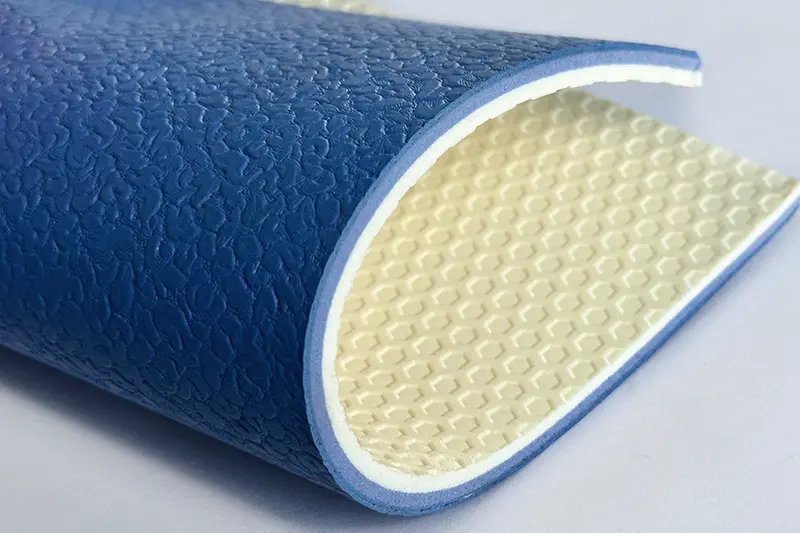
From a professional performance perspective, it excels in elasticity and shock absorption, with a standard thickness typically ranging from 4.5 to 8 mm. The foamed bottom layer effectively absorbs the impact of athletes jumping and running, reducing the burden on leg joints and meeting the International Tennis Federation (ITF) requirements for court rebound performance. The coefficient of friction is controlled between 0.5 and 0.7, and the surface treatment significantly improves the floor's wear resistance.
However, PVC tennis court flooring also has certain limitations; after all, every material has its advantages and disadvantages. Its weather resistance is relatively poor, unable to withstand long-term outdoor exposure to sunlight, rain, and extreme temperature changes, easily leading to aging, fading, and cracking. Therefore, it is very suitable for indoor venues.
Modular interlocking tennis court flooring is undoubtedly the best solution for outdoor tennis court surface installation. Why? Its superior weather resistance and adaptability make it perfectly suited to complex outdoor environments.
Its outstanding weather resistance comes from high-quality PP raw materials with added UV stabilizers, allowing it to withstand temperature changes from -30℃ to 60℃. It is unaffected by sun, rain, snow, or extreme cold, and will not warp, peel, or fade.
It boasts excellent drainage performance. The interlocking design allows for reasonable gaps, and the bottom support points create a suspended structure.
Outdoor interlocking sport tiles:
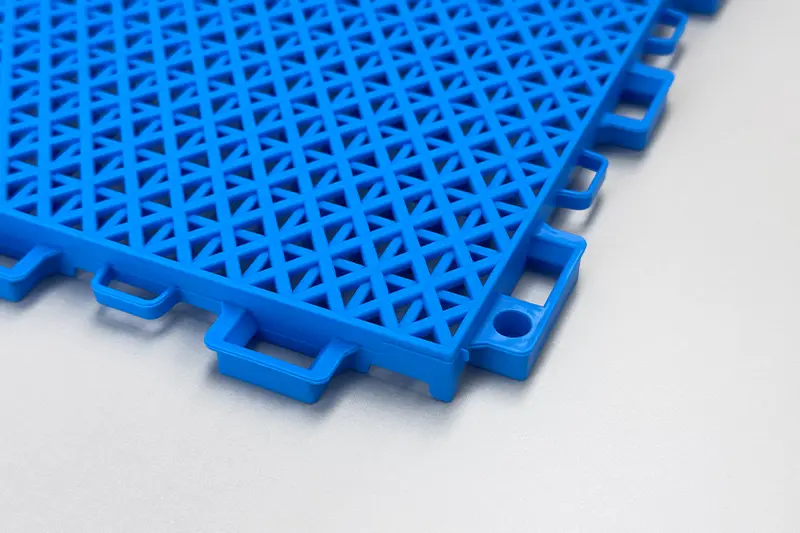
In terms of elasticity, the bottom support points, combined with cushioning pads, provide excellent cushioning and energy return. Its excellent vertical shock absorption reduces impact on athletes' joints while ensuring the stability of the tennis ball's rebound.
The most significant advantage is its ability to be disassembled and reassembled multiple times, making it suitable for temporary court setups and future relocations. It is also highly maintainable; if damaged, only a single tile needs to be replaced, eliminating the need to renovate the entire court.
Whether choosing PVC or outdoor suspended flooring, the flatness and strength of the court's foundation directly affect the installation effect and lifespan of the flooring.
The thickness of the flooring directly affects its elasticity, shock absorption, and wear resistance. The appropriate thickness must be selected based on the usage scenario and frequency of use to avoid insufficient thickness affecting the sports experience, or excessive thickness leading to wasted costs.
For indoor professional training halls and professional competition venues, a 5-8mm thick PVC sports floor is recommended. For school and community indoor venues, where usage frequency is lower, a 4.5-5mm thickness is suitable, balancing practicality and economy.
For outdoor suspended flooring, the number of tiles to be laid depends on the venue area. Thickness, perforation pattern, and cushioning design are key factors to consider during procurement. If the venue has high usage frequency, it is recommended to choose a floor with more cushioning and a thicker thickness.
Furthermore, as mentioned at the beginning, if your tennis court requires professional sports performance, it is best to choose tennis court flooring materials with ITF certification.

Leave Your Message
Message us for free samples and quotes!