Stable commitment to every leap, customized every flat
Blog


Suning County, Cangzhou City, Hebei Province, China
16630207375
dxfloor144@gmail.com
Stable commitment to every leap, customized every flat
Blog
As the fastest-growing sport globally, and a highly popular and in-demand sport for us sports flooring suppliers, pickleball courts adhere to standardized construction and material selection specifications from contract signing to completion. Based on the official tournament standards of the USA PPA (United States Pickleball Association) and the International Tennis Federation (ITF) surface performance certification system, this guide provides core principles for the entire process of indoor and outdoor pickleball court construction, from initial planning, material selection, construction management to acceptance and maintenance. It offers practical technical references for the construction of various scenarios, including commercial venues, community facilities, and professional tournament bases.
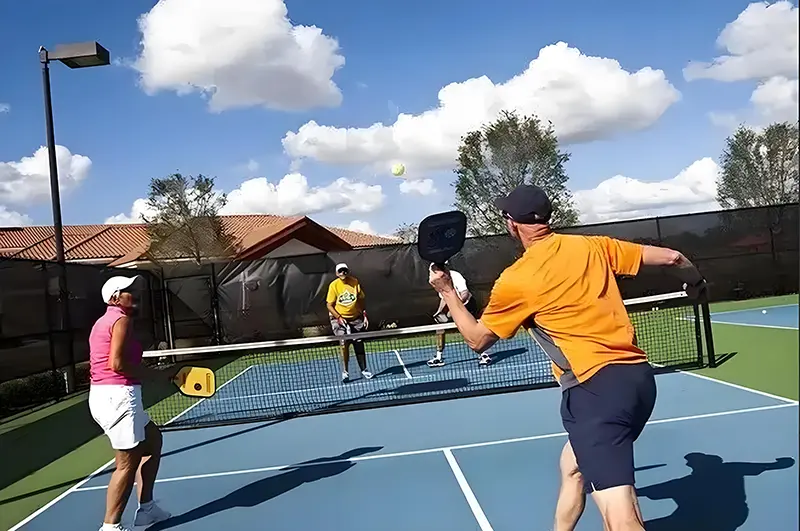
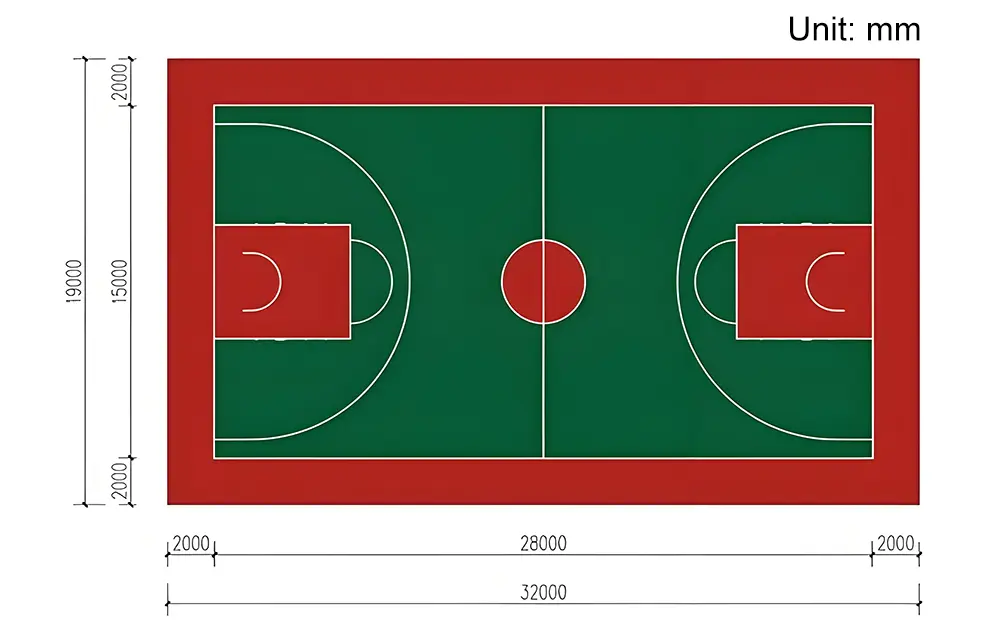
Specifications Standard pickleball courts are available in doubles and singles sizes. All lines are uniformly 50.8mm (2 inches) wide, and the lines themselves are part of the effective court area. Measurements must include the line width, with an error not exceeding ±3mm.
View our previously provided detailed pickleball court dimensions.
The lifespan of an outdoor pickleball field depends 70% on the quality of the subfloor. A smooth surface and the selection of suitable materials, such as acrylic pickleball flooring, offer excellent wear resistance and weather resistance, are specifically designed for outdoor use, and are suitable for various weather conditions and temperatures.
Supporting Facilities: The surface material must pass a UV aging test, ensuring no significant fading or chalking for at least 5 years; the fencing should be 3.05m high diamond-patterned galvanized wire mesh, raised to 3.66m for tournament-level fields, with posts embedded at a depth ≥600mm and secured using C20 concrete to prevent swaying; the lighting system should use 6-8m high-pole LED anti-glare lights, symmetrically arranged, with an illuminance of ≥300 lux for amateur fields, ≥500 lux for commercial fields, and ≥750 lux for tournament-level fields, with an illuminance uniformity ≥0.7, to prevent glare from interfering with players' vision.
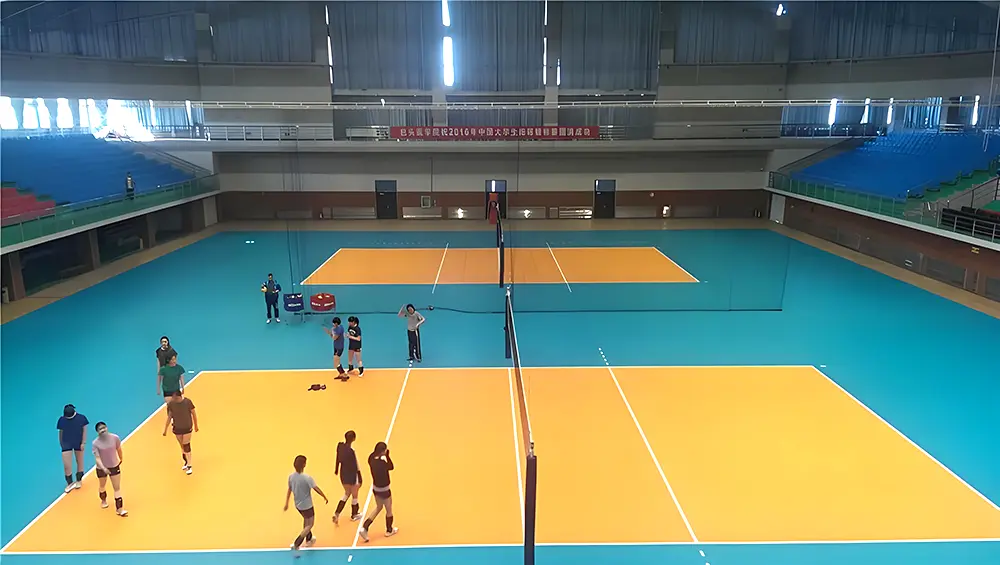
The minimum clear height for indoor pickleball courts is 5.49m (18 feet). Professional tournament-grade courts must have a clear height of ≥7.32m (24 feet). No beams, air ducts, fire hydrants, or other obstructions are permitted directly above the court to avoid interfering with the ball's trajectory. Column spacing must be appropriate for the court dimensions; a column spacing of ≥8m is recommended for a single court, and ≥16m for multiple adjacent courts, to prevent columns from encroaching on the buffer zone and affecting safety.
The concrete base layer must be tested for flatness; the error using a 2-meter straightedge must not exceed 2mm. The moisture content of the base layer must be ≤3%. The flooring material must fully consider the rebound rate and cushioning performance of pickleball. For indoor use, PVC pickleball court floor are the most cost-effective and popular choice. The peak noise level of a pickleball impact can reach over 85 decibels; PVC roll materials can effectively reduce the noise generated by the ball landing. The overall sound insulation of the venue must be ≥45dB; if surrounding buildings are present, sound insulation should be considered.
Hard Court Acrylic Surface: Highest USAPA certification coverage, stable rebound, strong weather resistance, UV resistance, moderate cost, simple maintenance, and a wide range of colors available; however, its cushioning performance is insufficient. Therefore, we adopted a solution combining PVC material and an acrylic coating, which combines the performance advantages of both materials.
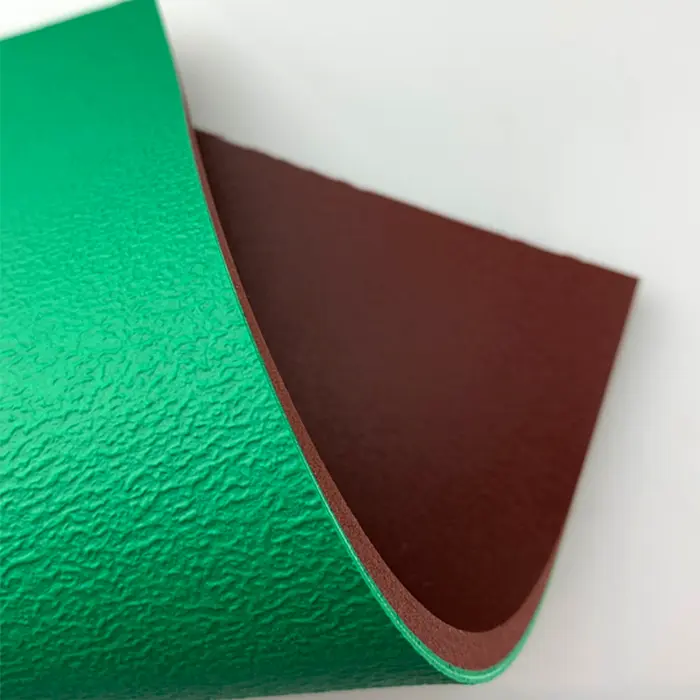
PVC Sports Flooring Rolls: Excellent sound insulation, comfortable feel underfoot, good cushioning performance, quick installation, customizable patterns, solvent-free and environmentally friendly.
Modular Interlocking Flooring: Quick installation, no subfloor preparation required, movable, low cost, and good drainage.
Suitable materials can be selected based on the indoor and outdoor environment.
Complete all aspects of the project, including site selection, geological survey, site dimensions, buffer zone planning, subfloor structure, drainage system, lighting and fencing, and fire evacuation arrangements, to avoid rework later.
Construction follows a layered process. After each layer is completed, compaction, flatness, strength, and moisture content must be tested. The concrete subfloor must be cured for at least 28 days.
The construction environment temperature should be controlled between 10-35℃, and the humidity ≤85%. Construction is strictly prohibited in rainy, windy, or freezing weather.
For wear-resistant line marking paint, use a laser line marker for precise positioning to ensure the straightness and dimensional accuracy of the lines. The lines must be applied evenly, without burrs, runs, or peeling. An abrasion resistance test must be conducted after complete drying.
The fencing, lighting, nets, referee chairs, and other supporting facilities must be installed strictly according to the drawings. The fencing posts must be vertical and secure. The lighting illuminance must be adjusted to avoid glare. The net installation must ensure that the height and tension meet standards.
A comprehensive inspection and acceptance process will be conducted, including dimensional accuracy, surface rebound rate, coefficient of friction, flatness, lighting illuminance, drainage performance, and fire safety compliance. The facility can only be put into use after all indicators pass.
In summary: When planning a pickleball court sports center, the ground base and flooring materials are crucial. Whether indoors or outdoors, adhering to construction standards will create your own personalized pickleball court.

Leave Your Message
Message us for free samples and quotes!