Stable commitment to every leap, customized every flat
Blog


Suning County, Cangzhou City, Hebei Province, China
16630207375
dxfloor144@gmail.com
Stable commitment to every leap, customized every flat
Blog
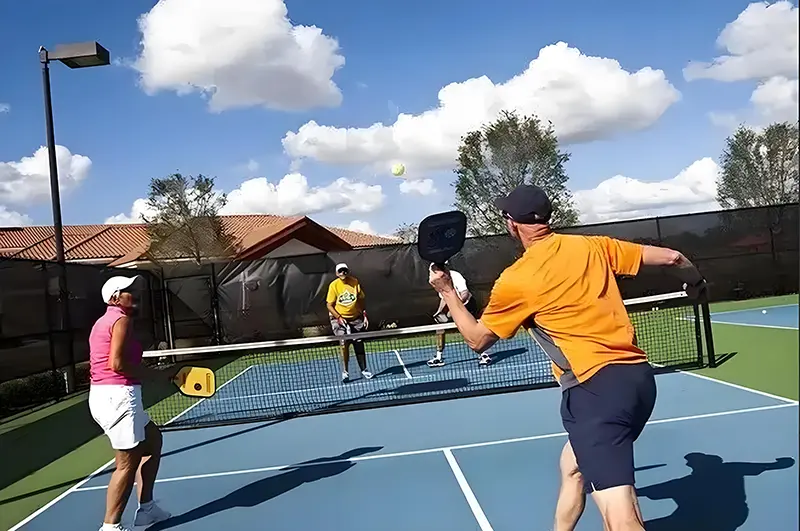
PVC vinyl sports flooring is commonly used as the surface material for pickleball courts, making it an optimal choice for both indoor and outdoor use. Understanding the international standard dimensions of pickleball courts and the required flooring dimensions facilitates the creation of standardized sports facilities that meet the needs of pickleball players. This also directly determines the fairness of the sport. We comprehensively explain the core dimensions and flooring specifications for reference, combining IPF standards and court acceptance specifications.
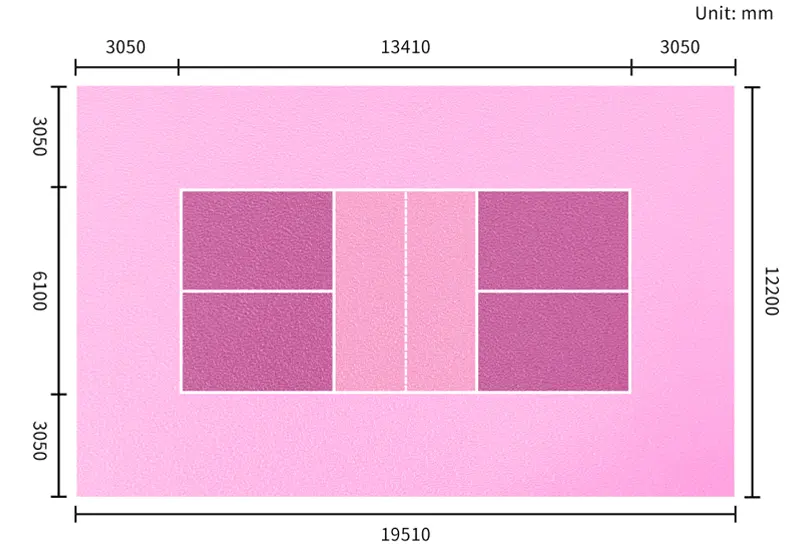
Pickleball court dimensions have clear internationally unified standards. Whether it's singles, doubles, or special wheelchair events, there are strict dimensional definitions. This is the fundamental basis for PVC flooring installation and must be accurately positioned before construction.
According to IPF (International Pickleball Federation) standards, a standard pickleball court is rectangular, with overall dimensions of 13.41m × 6.10m (length × width). This dimension covers the core playing area and the width of the boundary lines. The key area dimensions are as follows:
End Lines and Sidelines: The end lines are the boundary lines at both ends of the court's long axis, with a length of 6.10m; the sidelines are the boundary lines on both sides of the court's short axis, with a length of 13.41m. The width of both boundary lines is uniformly 5cm and must be painted with a special paint that contrasts sharply with the PVC flooring color, with an error margin controlled within ±2mm.
Service Area: Located behind the end lines, it is divided into two symmetrical areas by the center line and the extension of the sidelines. The standard dimensions of each service area are 3.66m (length) × 2.44m (width). When serving, the player's feet must be completely within the service area. After hitting the ball, the player can move into other areas; therefore, the PVC flooring in this area needs to have stronger anti-slip properties to accommodate sudden stops during serves.
Non-Volley Area (commonly known as the "kitchen"): This is the core feature area of the Peak court, located on both sides of the net, extending 2.13m inwards from the court, with a width consistent with the court (6.10m). This area prohibits players from volleying the ball and is a high-frequency movement area during the game, requiring the highest elasticity and wear resistance from the PVC flooring.
Net Dimensions: The net height is 91.4cm (both ends) and 86.4cm (middle). The net post spacing is consistent with the court width (6.10m). The net posts must be fixed outside the sidelines to avoid occupying effective court space. Space must be reserved for net post installation during PVC flooring installation to prevent damage to the flooring integrity during later cutting.
The core area dimensions of the singles and doubles courts in Peakball are the same, only the sidelines differ. No additional adjustments to the overall dimensions are needed during PVC flooring installation; only lines are used to distinguish the areas:
Doubles Court: Uses the entire court area, i.e., the complete dimensions of 13.41m × 6.10m. Both sidelines and end lines are valid boundary lines.
Singles Court: Based on the doubles court layout, the sidelines are narrowed inwards, resulting in an effective width of 5.18m and a length of 13.41m. The narrowed area must be clearly marked with lines, and the PVC flooring must be laid flat to avoid unevenness at the marked lines.
For special groups and usage scenarios, the court dimensions are adjusted accordingly, and the PVC flooring must be customized based on the adjusted dimensions: Wheelchair Race Court: Considering the mobility requirements of wheelchairs, the buffer zone needs to be enlarged, expanding the overall dimensions to 22.56m × 13.41m. The core playing area remains at 13.41m × 6.10m. The expanded area must use the same specifications of PVC flooring to ensure consistency in the surface material.
Training-grade courts: For daily training or general fitness, the perimeter buffer zone can be appropriately reduced while maintaining the core area dimensions (13.41m × 6.10m). However, the buffer zone width should not be less than 1.5m, otherwise it will affect the safety of sports activities. PVC flooring should cover the entire training area to avoid material differences at the joints.
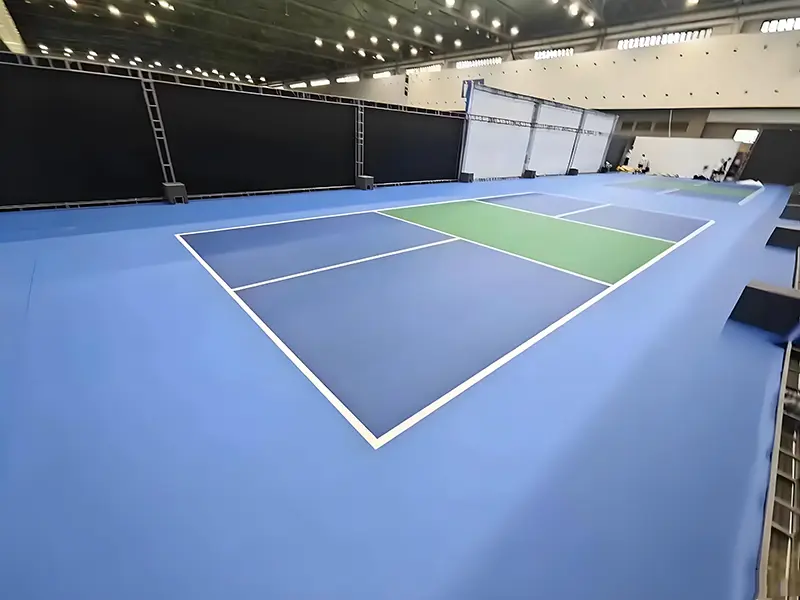
Roll PVC flooring: The mainstream width is 1.8m or 2.0m, and the length is 20m or 30m. Taking a 1.8m wide roll as an example, when laying a 6.10m wide court, 4 rolls are required (1.8m × 3 = 5.4m, the remaining 0.7m needs to be cut and spliced). The longitudinal length of 13.41m can be directly cut. The joints must be treated with heat welding to avoid dust accumulation or affecting gliding.
Modular interlocking tiles: Common tile sizes are 300mm×300mm or 500mm×500mm, using an interlocking design. For standard site installation, 12-13 tiles are needed horizontally (6.10m ÷ 0.5m ≈ 12.2 tiles) and 27 tiles vertically (13.41m ÷ 0.5m ≈ 26.82 tiles). Precise cutting is required at the corners, and the cut edges must be smoothly sanded to avoid sharp burrs.
Whether indoors or outdoors, vinyl rolls are typically 3mm thick; professional-grade options include 2.5mm.
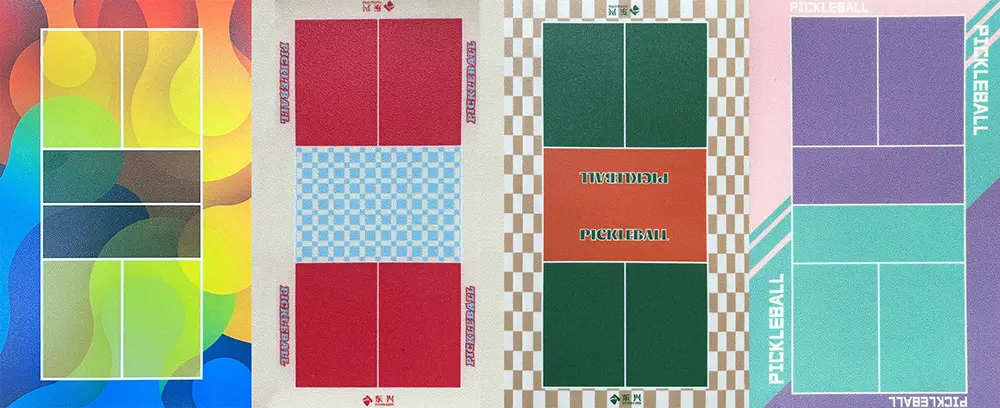
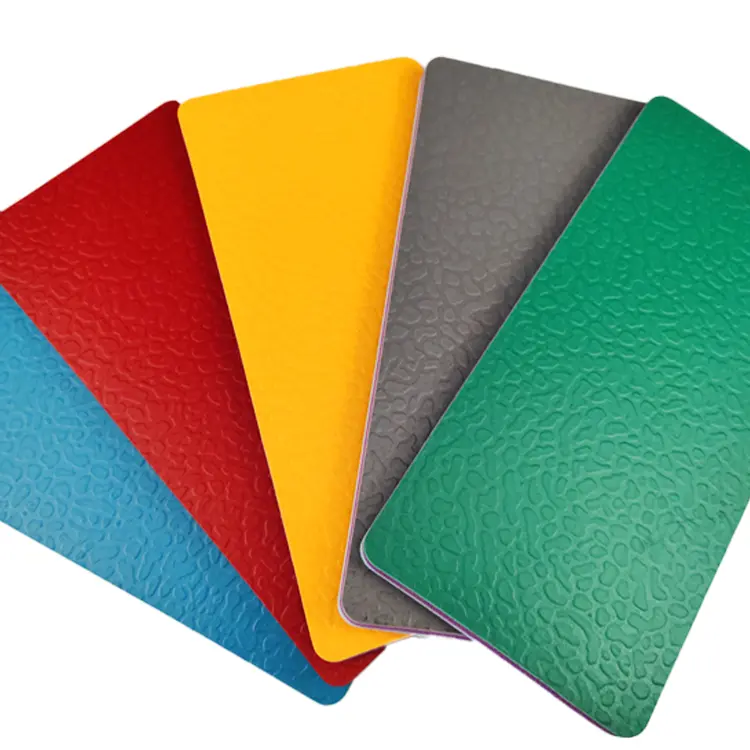
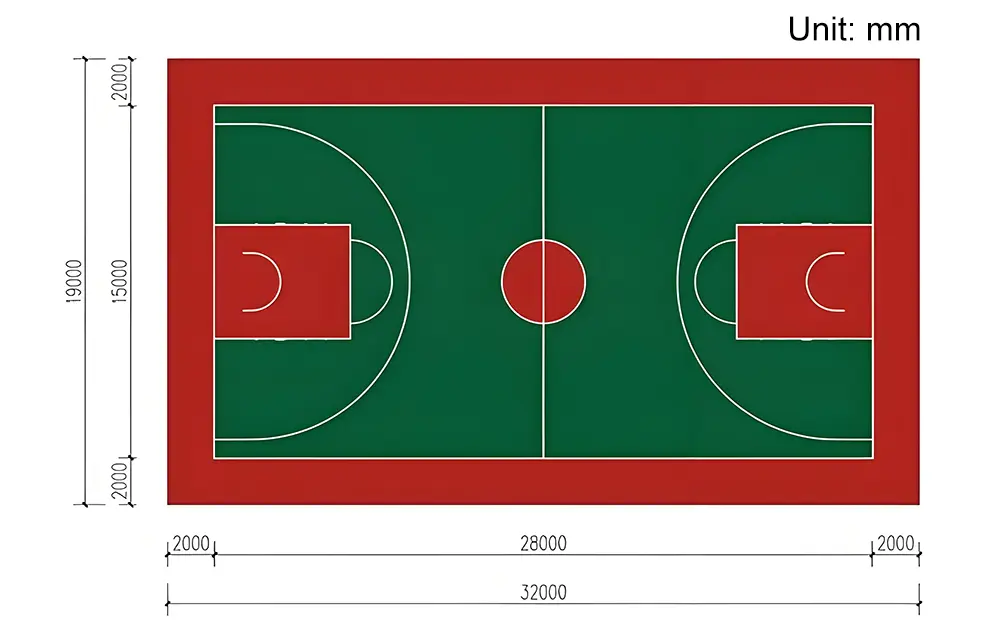
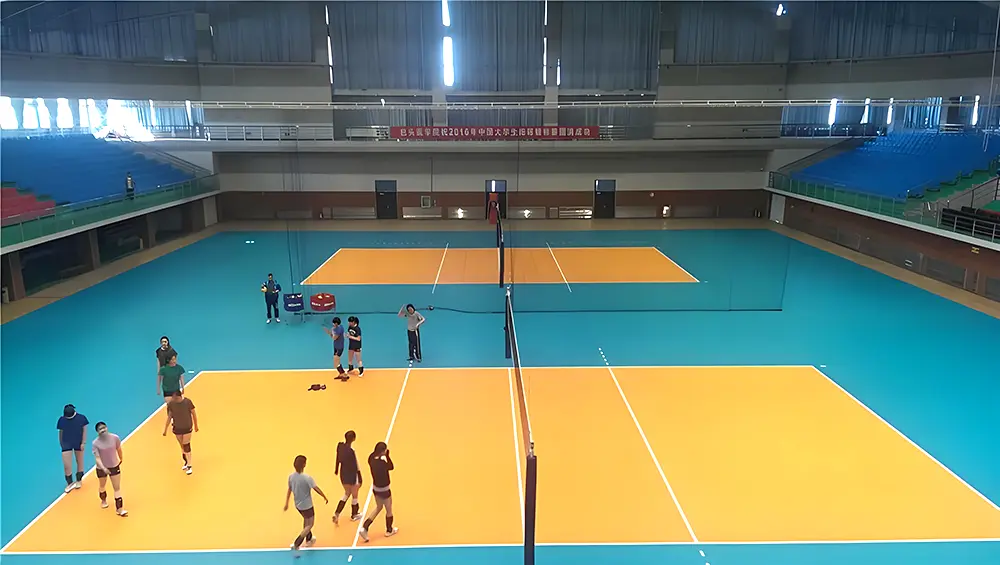
Patterns, colors, and logos can be customized to meet specific needs. Below are some design examples for reference:
Overall Dimensions: Measure the length and width of the court using a steel tape measure. Standard dimensions are 13.41m × 6.10m, with an allowable error ≤ 5mm; the effective width of the singles court is 5.18m, with an error ≤ 3mm.
Area Dimensions: Service area 3.66m × 2.44m, non-volley area 2.13m × 6.10m, with dimensional errors ≤ 5mm; line width 5cm, error ±2mm, line straightness error ≤ 1mm/m.
Flatness: Use a 3m straightedge to check the PVC floor surface. The gap between any 2m straightedge should not exceed 4mm, and the pass rate for the court surface flatness test points should not be less than 80%.
Sports Performance: Ball rebound rate ≥90% (competition grade), ≥75% (training grade), with the difference between the results at each test point and the average value ≤±3%; anti-slip value 80BPN-110BPN in dry condition, 60-90BPN in wet condition, with the range of test points on the same field ≤10BPN.
Physical Properties: Tensile strength ≥15MPa, elongation at break ≥150%, dimensional change rate upon heating ≤0.5%.
Environmental Performance: Vinyl chloride monomer content ≤5mg/kg, formaldehyde emission ≤0.1mg/m³・h, ensuring no odor or health hazards for indoor use.
Dimensional deviations: mostly due to inaccurate marking or uneven substrate.
Joint warping: mainly due to insufficient welding temperature or insufficient rolling, requiring re-welding with a hot air welding gun.
Blurred or detached lines: due to improper paint selection or uncleaned surface, requiring removal and re-marking of existing lines.
Floor buckling: This is often caused by insufficient expansion joints. The floor needs to be cut along the buckling point to make up for the expansion joint.


Leave Your Message
Message us for free samples and quotes!