Stable commitment to every leap, customized every flat
Blog


Suning County, Cangzhou City, Hebei Province, China
16630207375
dxfloor144@gmail.com
Stable commitment to every leap, customized every flat
Blog
For high school basketball event operations, school sports infrastructure, and youth basketball training, accurately understanding high school basketball court dimensions is crucial for court construction and the procurement of basketball flooring materials. This article, based on the 2024-2025 season basketball rulebook officially released by the National Federation of State High School Associations (NFHS), and in conjunction with FIBA, comprehensively breaks down the core dimensions, line marking standards, and supporting area specifications for high school basketball courts. It also compares the dimensional differences between different competition systems to answer core questions regarding court construction and compliance verification.
Globally, the core reference standard for high school basketball court dimensions is the specification established by the National Federation of State High School Associations (NFHS). This standard is the sole compliance basis for state high school basketball leagues in the United States and is one of the most widely referenced standards for high school basketball court construction worldwide.
The NFHS clearly stipulates that the standard high school basketball court's inner dimensions are 84 feet (25.60 meters) long and 50 feet (15.24 meters) wide. The court is a standard rectangle, with all four sidelines and end lines strictly perpendicular. The diagonal length error must not exceed ±0.5 inches (1.27 centimeters) to ensure the court's absolute squareness.
This size differs significantly by 10 feet from the NCAA and NBA's standard 94 feet (28.65 meters). The design intention is to accommodate the physical development of high school students aged 14-18. The shorter court length reduces the physical exertion of young players, minimizes the risk of sports injuries from long-distance running, and better suits the offensive and defensive transitions of high school students, avoiding a decrease in the spectator appeal and competitiveness of the game due to an excessively large court.
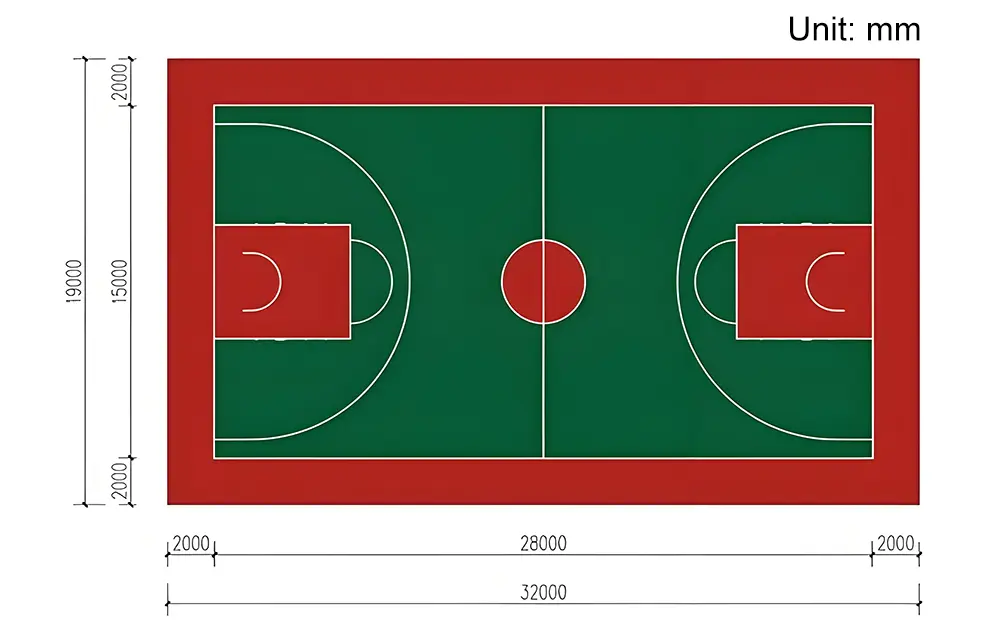
The standard width of the four boundary lines of the court (two longer sides as sidelines and two shorter sides as end lines) is 2 inches (5.08 cm). The width of all boundary lines is not included in the net dimensions of the court; that is, the length and width of the court are measured from the inner edges of the sidelines and end lines.
Center Line Specifications: The center line connects the midpoints of the two sidelines, is parallel to the end lines, and is also 2 inches wide. The two endpoints of the center line extend 6 inches (15.24 cm) outward from the sidelines to clearly define the boundary between the front and back courts, meeting the visual requirements for referees to call backcourt violations.
The center line also divides the court into two equal halves, each 42 feet (12.80 meters) long. This half-court dimension is the core reference standard for the construction of 3v3 basketball courts and daily training facilities in high school campuses.
The three-point line is one of the areas in high school basketball courts where the dimensions differ most significantly from those in adult games. The NFHS official specifications for the high school basketball three-point line are as follows:
Arc Radius: An arc with a radius of 19 feet 9 inches (6.02 meters) is drawn, centered on the horizontal projection of the basket's center onto the ground. The ends of the arc should be tangent to the straight line segment at the baseline.
Bottom Line Segment: The straight line segment extending from the ends of the arc towards the baseline must be parallel to the sideline and 3 feet (0.91 meters) from the inside edge of the sideline to avoid overlap between the three-point line and the sideline, which could lead to controversial calls.
Line Width Requirements: The three-point line width is uniformly 2 inches. The line width is not included in the effective radius of the three-point line; the radius measurement is based on the inside edge of the three-point line.
This size is significantly smaller than the FIBA three-point line radius of 6.75 meters and the NBA's 7.24 meters. Its core design principle is to suit the upper body strength and shooting range of high school students, allowing young players to complete three-point shots within a reasonable range of force, avoiding shooting form distortion and joint injuries caused by excessive force, while also maintaining the entertainment value and competitiveness of the games. Since the 2024 season, the NFHS has standardized the three-point line for boys' and girls' high school basketball games, eliminating the previous size differences between boys' and girls' games and achieving rule unification.
The restricted area (commonly known as the three-second zone) of the NFHS high school basketball court is a standard rectangular structure, clearly distinguishing it from the trapezoidal restricted area currently used by FIBA. Its core dimensions are as follows:
Overall Restricted Area Dimensions:
Width: 12 feet (3.66 meters), Length: 19 feet (5.79 meters). Two sidelines connect the ends of the free throw line to the inner edge of the end line, forming a closed rectangle.
Free Throw Line Specifications: The free throw line is parallel to the end line, 2 inches wide, with its outer edge 19 feet (5.79 meters) from the inner edge of the end line. The midpoint of the free throw line coincides with the center line of the court, and its total length is 12 feet (3.66 meters).
The outer edge of the free throw line is 15 feet (4.57 meters) from the horizontal projection of the center of the basket. These dimensions are consistent with those of the NBA, NCAA, and FIBA. The standards are completely consistent, with the core purpose of ensuring standardized training of free throw techniques for young players and achieving seamless transitions to higher-level competitions.
Free Throw Positioning Line Specifications: Free throw rebounding positioning lines must be marked on both sides of the restricted area, with a line width of 2 inches. The first positioning zone is 3 feet (0.91 meters) from the inside edge of the end line and has a width of 22 inches (55.88 centimeters). An 8-inch (20.32 centimeters) wide neutral zone is established between adjacent positioning zones; only referees can enter the neutral zone. The width of all positioning lines is included in the dimensions of the corresponding zones.
The backboard and hoop are the core fixed structures of a high school basketball court. NFHS specifications are highly consistent with international standards to ensure consistency in player movement habits. The core dimensions are as follows:
Backboard Standards: A standard game backboard is rectangular, 6 feet (1.83 meters) wide and 4 feet (1.22 meters) high. The bottom edge of the backboard is 10 feet (3.05 meters) vertically from the ground.
A 2-inch wide white target rectangle must be drawn on the front of the backboard. The rectangle is 24 inches (61 centimeters) wide and 18 inches (45.72 centimeters) high, with the bottom edge of the rectangle flush with the top edge of the rim.
Hoop Specifications: The inner diameter of the rim is 18 inches (45.72 centimeters). The top edge of the rim is 10 feet (3.05 meters) vertically from the ground, with a tolerance not exceeding ±0.25 inches (0.64 centimeters). The horizontal projection of the center of the rim onto the ground is the clear distance from the inner edge of the end line. 5 feet 3 inches (1.60 meters) is the core benchmark for verifying the accuracy of the three-point line and free-throw line dimensions.
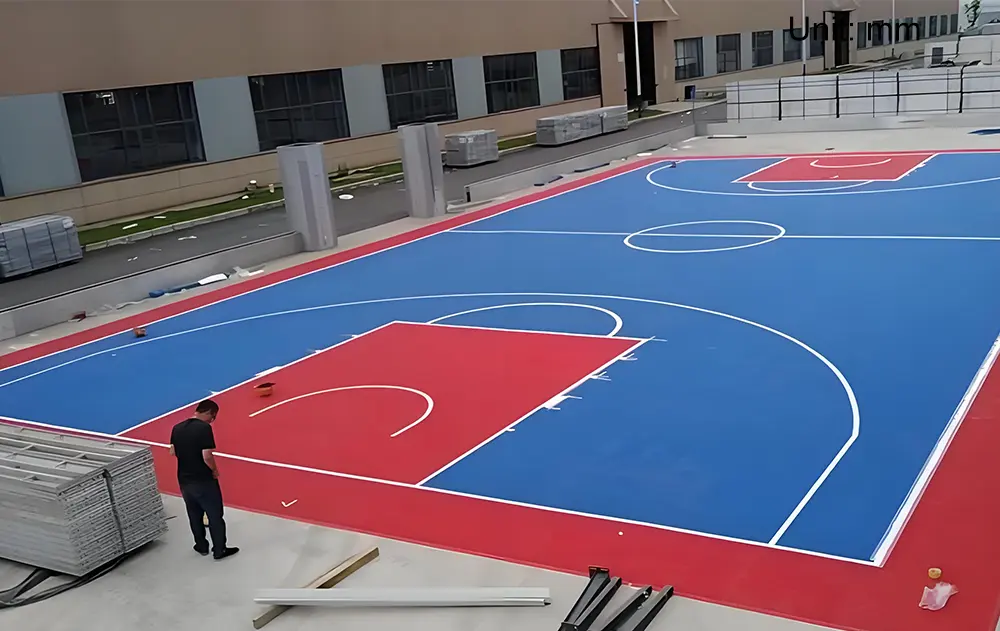
Inner court dimensions: 25.60m (length) × 15.24m (width)
Minimum buffer zone outside sidelines: 0.91m (3 feet)
Minimum buffer zone outside end lines: 3.05m (10 feet)
Minimum total dimensions for PVC flooring installation: 31.70m (length) × 17.06m (width).
Note: Both NFHS and FIBA explicitly require that the buffer zone of tournament-grade courts must be made of the same PVC flooring as the inner court. Using different materials such as tiles or cement is strictly prohibited to prevent players from slipping and getting injured due to sudden changes in friction when retrieving the ball. This is a veto item for tournament court certification.
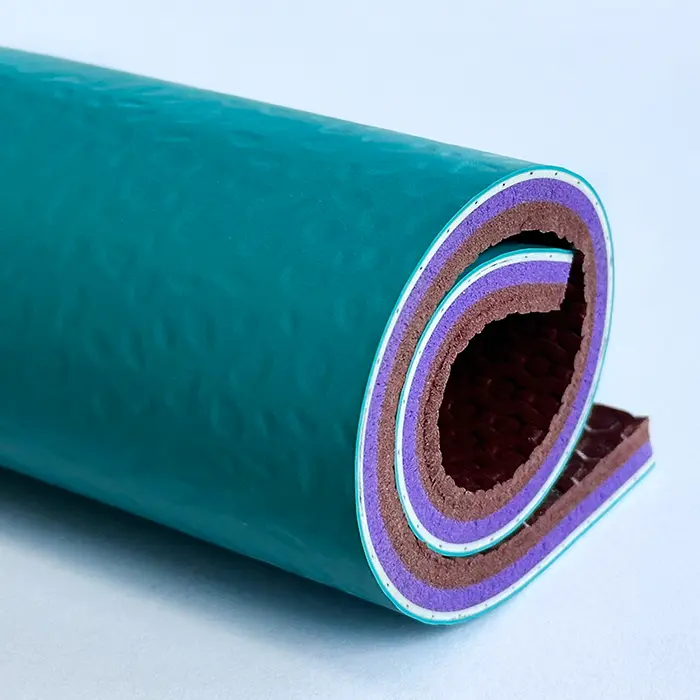
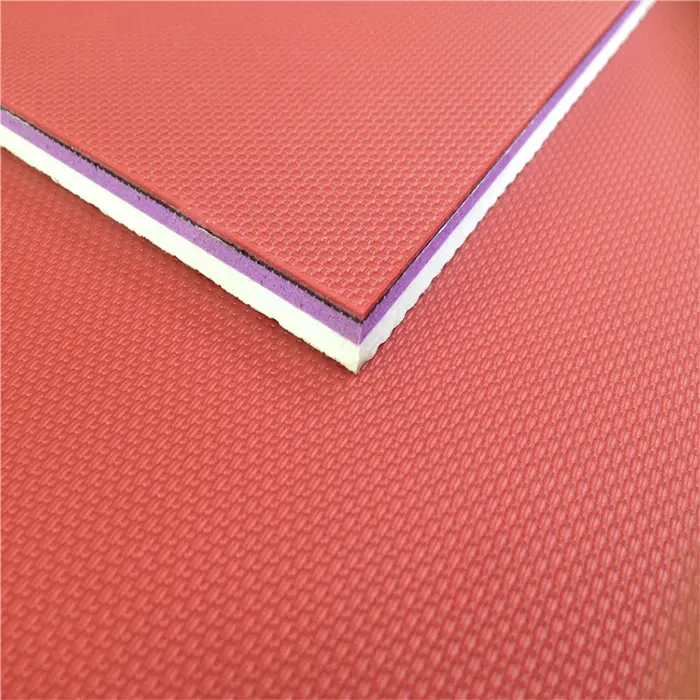
Produced in whole rolls with seamless splicing, this is the only designated product for official competition venues. Its core dimensions are as follows:
Standard Width: Mainstream compliant sizes are 1.8m, 2.0m, 2.2m, and 2.5m. High schools prioritize 1.8m and 2.0m widths to precisely match the court width, reduce cutting waste, and avoid seams falling in key playing areas.
Standard Length: Regular factory specifications are 15m/roll, 20m/roll, and 25m/roll. High school full-court courts prioritize custom-made 26m (NFHS)/29m (FIBA) whole rolls to reduce longitudinal seams and improve the overall integrity and durability of the court.
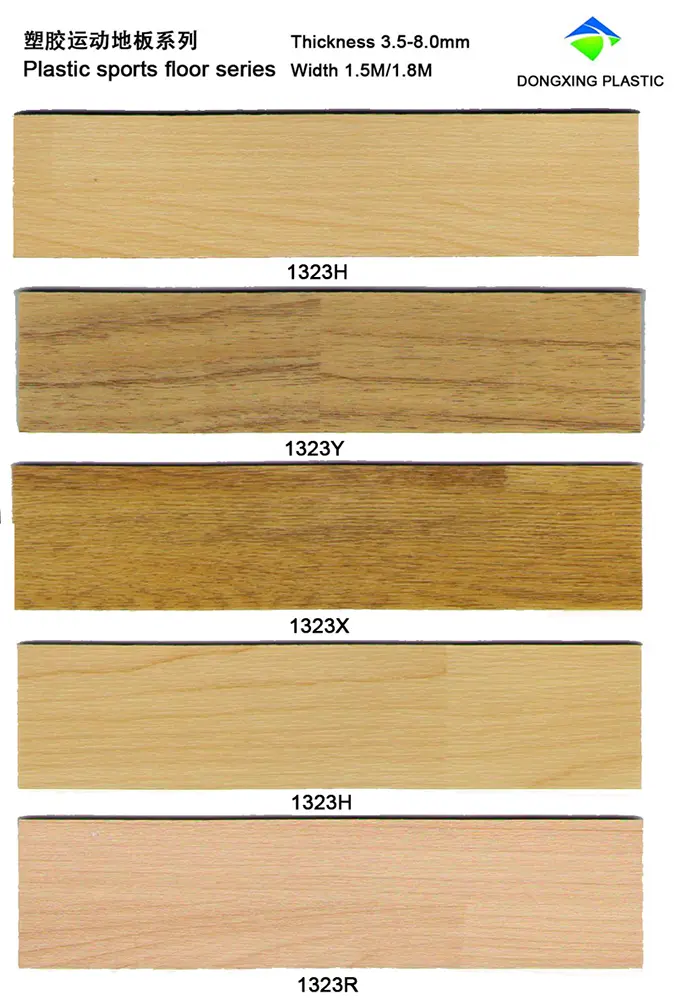
PVC Hot Melt Welding Specifications (Mandatory): The gap between the seams of adjacent rolls must be controlled within... The weld thickness should be 0.5mm-1.0mm, with a weld width ≤2mm after welding. The weld excess must be ground flush with the floor surface, with a height difference tolerance ≤±0.2mm. Protrusions or depressions are strictly prohibited to prevent students from tripping and to prevent sweat and dust from seeping in and causing the floor to delaminate. No seams are allowed in core competition areas (free throw area, restricted area, three-point line arc, and under-basket landing area). All seams must be located in non-marked, non-high-frequency-traffic areas to prevent line cracking and excessive wear at the seams. The gap between interlocking basketball court tiles should be ≤0.2mm, and the height difference between adjacent tiles ≤0.1mm. Warping and loosening are strictly prohibited, meeting the safety standards for school sports fields.
As a Chinese manufacturer of sports flooring, we have extensive production experience and a thorough understanding of the dimensions required for school sports courts. Dimensions are crucial for building a standard basketball court. Welcome to consult us for your customized solutions!

Leave Your Message
Message us for free samples and quotes!