Stable commitment to every leap, customized every flat
Blog


Suning County, Cangzhou City, Hebei Province, China
16630207375
dxfloor144@gmail.com
Stable commitment to every leap, customized every flat
Blog
Professional indoor basketball courts use solid wood flooring, a material that balances ball rebound, cushioning, player protection, and durability. It's also the standard flooring material for FIBA (International Basketball Federation) certified events. Basketball enthusiasts and venue buyers worldwide frequently ask: What kind of wood is used for indoor basketball court flooring? What are the differences between different joist structures (single joist/double joist/main and secondary joist)? What's the difference between flooring with and without shock-absorbing pads? This article will explore these three core areas to help you gain a deeper understanding of the materials and types of solid wood sports flooring.
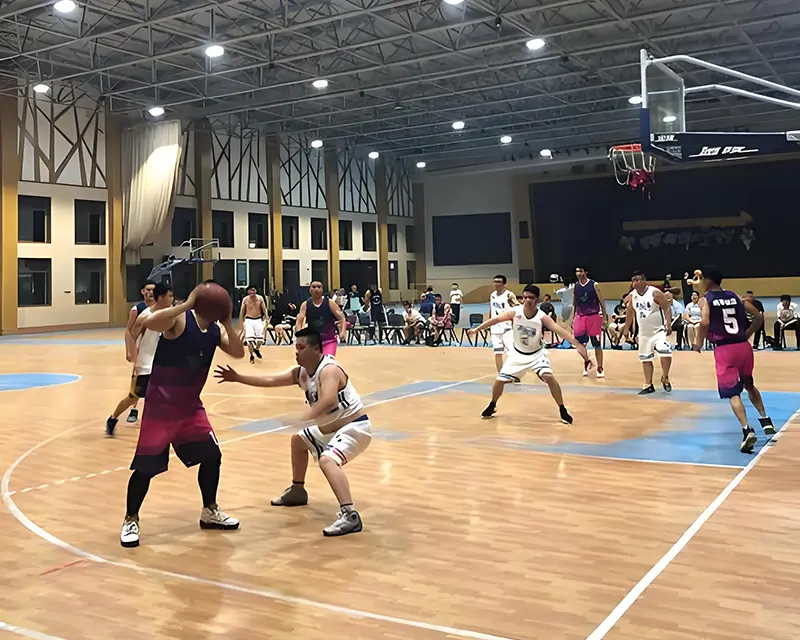
Advantages include: uniform density, hard texture, moderate elasticity, minimal color variation, straight and fine grain, excellent wear and scratch resistance, ball rebound rate of 92%-95%, and extremely strong impact absorption stability. It fully meets FIBA Tier 1 standards, with a moderate, non-reflective surface gloss that maximizes player vision protection and provides precise foot feedback. It's the sole choice for top-tier venues like the NBA, CBA, and World Championships.
If you're looking to build a professional basketball arena, international competition venue, or high-end training center, this solid wood sports flooring material is ideal.
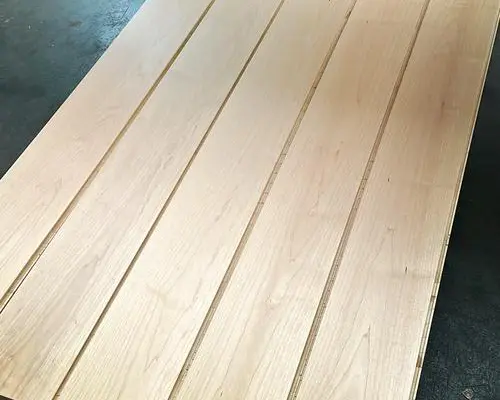
Advantages include: performance close to maple, balanced hardness and elasticity, and a price only 60%-70% of North American maple. Its color variation is slightly greater than maple, and its wear resistance meets professional training requirements.
It has achieved FIBA Tier 2 certification, boasts a ball rebound rate of 88%-92%, meets impact absorption standards, and offers excellent value for money, making it a mainstream material for professional basketball court flooring.
This type of solid wood material is most suitable for building city-level training halls, university gymnasiums, and commercial basketball courts.
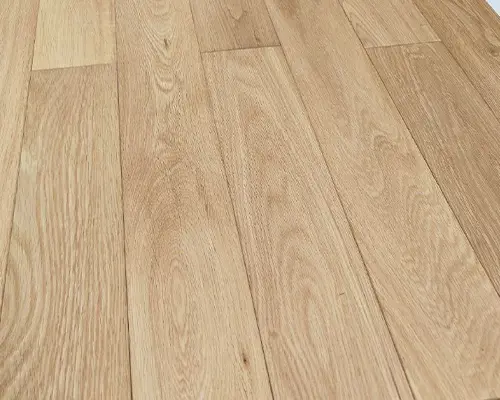
Advantages: Harder texture, stronger load-bearing capacity, coarser grain, and better wear resistance than maple, but slightly less elastic, resulting in a slightly lower ball rebound rate (85%-88%).
Impact-resistant and durable, suitable for venues with high-frequency use and heavy equipment traffic, and lower cost than maple.
Suitable for community gymnasiums, school multi-purpose stadiums, and low-frequency sports venues.
Note: Ordinary solid wood, composite flooring, and engineered wood flooring are strictly prohibited for basketball courts. Grade A solid wood veneer with a thickness standard of 18mm-22mm is mandatory; this is the basic requirement for FIBA certification. Therefore, regardless of the type of solid wood you choose, it must meet these basic requirements.
While we are a PVC sports flooring manufacturer, we also produce solid wood flooring. There are three main structural options for basketball solid wood sports flooring:
The joist structure is the load-bearing skeleton of the basketball wood flooring, directly determining the floor's load-bearing capacity, cushioning, stability, and lifespan. It is also the core difference between professional and ordinary basketball wood flooring. Currently, the industry mainstream is the three main structures: single joist, double joist, and main and secondary joist.
Structural Composition: Consists of solid wood panels + subfloor + single-layer main joist + leveling pad. The joists are made of 40mm×80mm high-quality pine/larch, evenly laid at 400mm intervals. This is the most basic professional structure in the industry.
Strength Principle: The single-layer joist bears the load vertically, with moderate elasticity, meeting the basic impact absorption and ball rebound requirements. Installation is simple and stability is strong.
Core Advantages: Moderate cost, short installation period, simple maintenance, small floor height (approximately 100mm total height), suitable for most indoor venues.
Applicable Scenarios: Primary and secondary school gymnasiums, community basketball courts, general commercial stadiums, training venues.
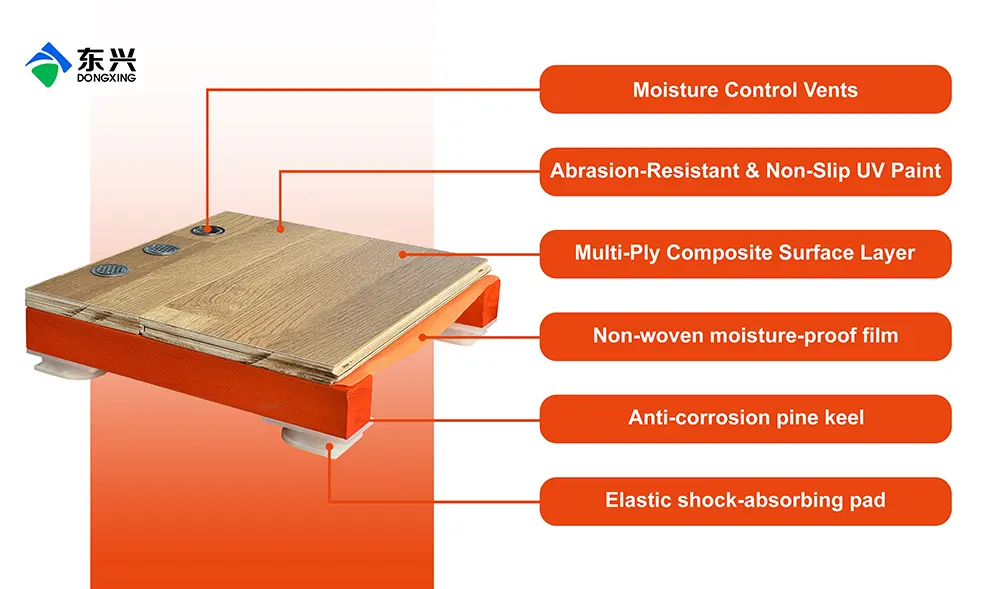
Structural Composition: Panel + Subfloor + two layers of parallel keels (upper main keel + lower secondary keel, laid vertically and crosswise), keel specifications 40mm×80mm, double-layer spacing is denser, doubling the overall load-bearing area.
Force Principle: Double-layer keel disperses impact force, resulting in more even elasticity, increased load-bearing capacity by 50%, and impact absorption rate of 45%-60%, far exceeding single-keel, maximizing ball rebound consistency.
Core Advantages: Near-top-level sports performance, better shock absorption and knee protection, no deformation or collapse after long-term use, suitable for high-frequency, high-intensity use.
Applicable Scenarios: Professional basketball training halls, provincial-level competition venues, high-end commercial stadiums.
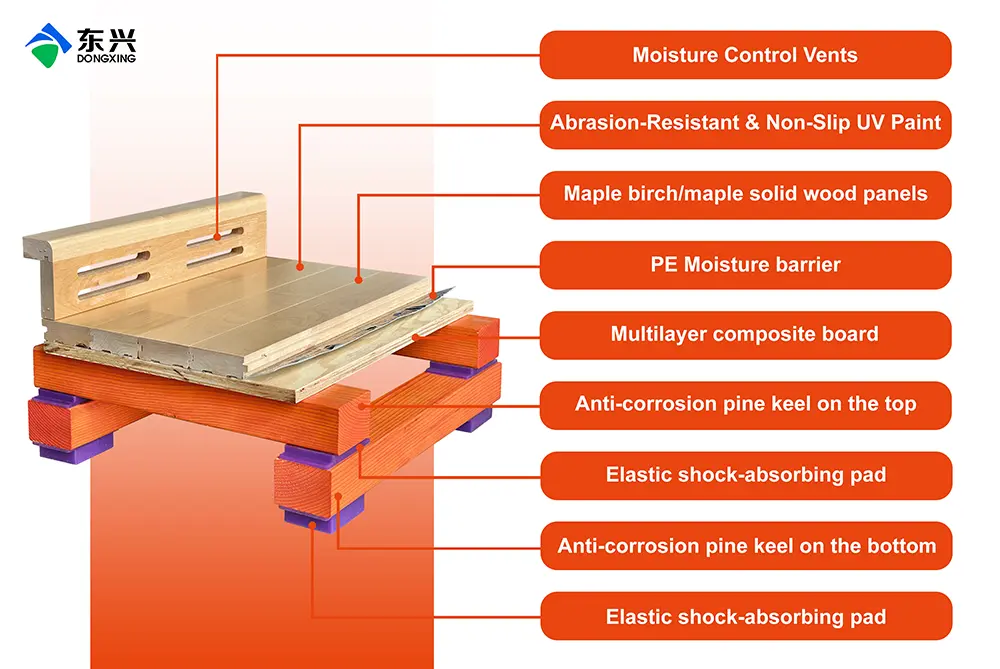
Structural Composition: Panel + Subfloor + Main Keel + Secondary Keel + Leveling Support. The main keel bears the load, while the secondary keel provides supplementary elasticity. Combined with a three-dimensional support structure, this is the top-of-the-line keel structure solution.
Force Principle: The main keel bears the heavy load, while the secondary keel optimizes elastic cushioning. The three-dimensional force design fully matches all performance indicators of FIBA top-level competitions.
Core Advantages: Strongest load-bearing capacity, optimal cushioning, maximum stability, service life of over 20 years, no localized collapse or elasticity decay issues.
Applicable Scenarios: NBA/CBA professional stadiums, international basketball competition venues, top-tier sports centers.
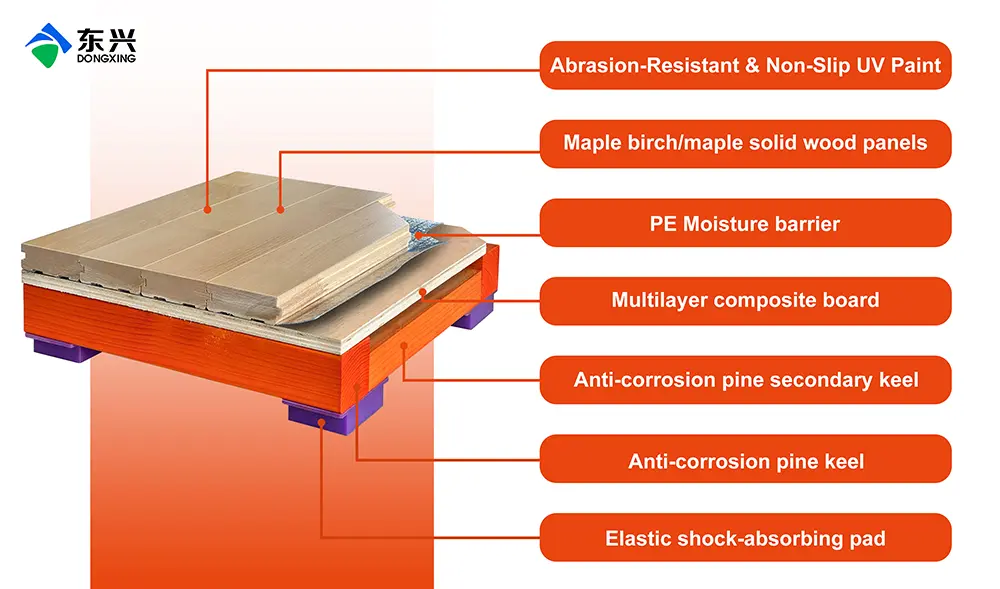
The bottom of the sports wood flooring keel is evenly covered with rubber shock-absorbing pads, 8mm-12mm thick, with support under each keel.
Functions include:
Improved impact absorption: Absorbs 40%-60% of the impact force upon landing, significantly reducing the risk of knee, ankle, and lumbar spine injuries for players;
Protecting the joist structure: Insulates the joists from direct contact with the ground, preventing cracking and deformation, and extending the floor's lifespan;
Noise and vibration reduction: Reduces sports noise and prevents vibrations from being transmitted to floors below;
Temperature and humidity adaptability: Buffers the stress from the thermal expansion and contraction of wood, preventing the floor from warping and cracking.
Suitable scenarios: All professional basketball courts, training halls, and competition venues (FIBA certification mandates padding).
Low-cost, padless version: The joists are directly fixed to the leveling layer of the ground, without any cushioning medium, resulting in a minimalist structure. It is low-cost and quick to install, but lacks cushioning performance. The impact force on players upon landing is entirely borne by their joints, increasing the risk of injury; the joists are also susceptible to moisture, deformation, and cracking, reducing their lifespan.
For solid wood flooring, if procurement costs are a concern, only one layer of cushioning padding can be added. For temporary competition venues, it may be unnecessary.** After all, solid wood flooring is much more expensive than PVC and other rubber materials, and its maintenance costs are also higher. It's best to choose flooring with padding to extend its lifespan and avoid frequent replacements.
A: Maple wood's density, elasticity, and wear resistance perfectly match the demands of basketball. Its ball rebound rate and impact absorption rate meet FIBA's top standards, and its fine, non-reflective texture makes it the only wood suitable for top-level competitions. Other woods cannot balance elasticity and durability.
A: Double-joist flooring has a double-layer cross structure, offering over 50% better cushioning, load-bearing capacity, and stability than single-joist flooring, making it suitable for professional, high-intensity use. Single-joist flooring is cheaper and faster to install, suitable for ordinary training venues, but its core disadvantage lies in athletic performance and durability.
A: It's acceptable for temporary, simple courts, but absolutely not for professional venues. Unpadded floors lack cushioning, increasing the risk of player injuries and causing the joists to deform, completely failing to meet the safety and professional standards of basketball.
A: It is currently the industry's top-of-the-line structure, offering unparalleled load-bearing capacity, cushioning, and stability. Designed specifically for top-tier international competitions, it's not necessary for ordinary venues.
A: FIBA-certified venues require 22mm, while 18mm-20mm is sufficient for ordinary training halls. Thickness directly affects ball bounce and feel; thicker panels offer greater stability.

Leave Your Message
Message us for free samples and quotes!