Stable commitment to every leap, customized every flat
Blog


Suning County, Cangzhou City, Hebei Province, China
16630207375
dxfloor144@gmail.com
Stable commitment to every leap, customized every flat
Blog
For dance, flooring performance needs to consider cushioning for dancers' feet and even their bodies upon landing. Simultaneously, to ensure smooth execution of various dance movements, the floor surface must possess adequate slip resistance and stability. These factors are related to the flooring materials and manufacturing processes. Meeting these performance standards, while considering usage frequency and the specific setting, necessitates choosing a more durable flooring material.
Wooden flooring for dance studios differs from residential wooden flooring because it heavily relies on tactile feedback. This is particularly important for ballet and modern dance, where dancers need to feel the weight and force of their landings to judge the appropriate range and height of their movements. This tactile feedback, also known as "foot feel," is crucial.
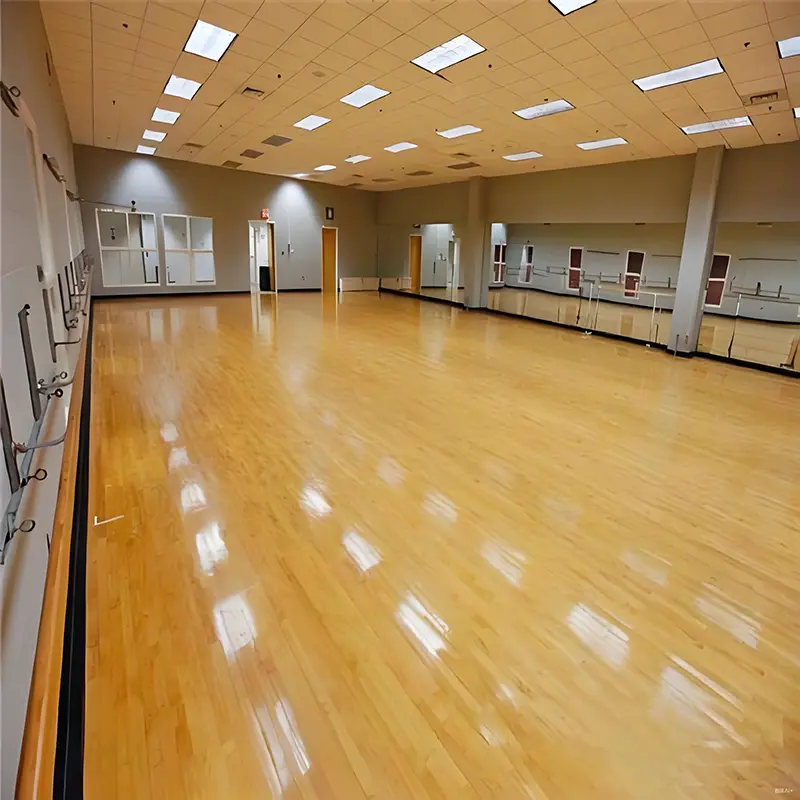
To achieve this, wooden flooring should possess a certain degree of elasticity and slip resistance.
Using native European and American woods, such as maple and oak, and adding moisture-proof and cushioning pads underneath, along with a degree of resilience, helps facilitate smooth transitions in dance movements.
The surface has a fine texture and an environmentally friendly coating, offering moderate grip when dry—neither too slippery to cause loss of control nor too rough to hinder spins and glides, making it suitable for ballet pointe work and modern dance flooring.
Solid wood flooring has a certain high-end feel, but frequent use may accelerate aging and increase maintenance costs, depending on the specific needs of the dance studio. The initial purchase cost is also higher, being solid wood, and the impact of air humidity must be considered, despite the use of moisture-proof pads and ventilation openings.
This material is more popular for dance surfaces and has a higher market share because it is inexpensive and meets the performance requirements of dance studios. Similar to vinyl sports flooring, wood and PVC materials each have their own advantages. Of course, the best choice depends on actual needs.
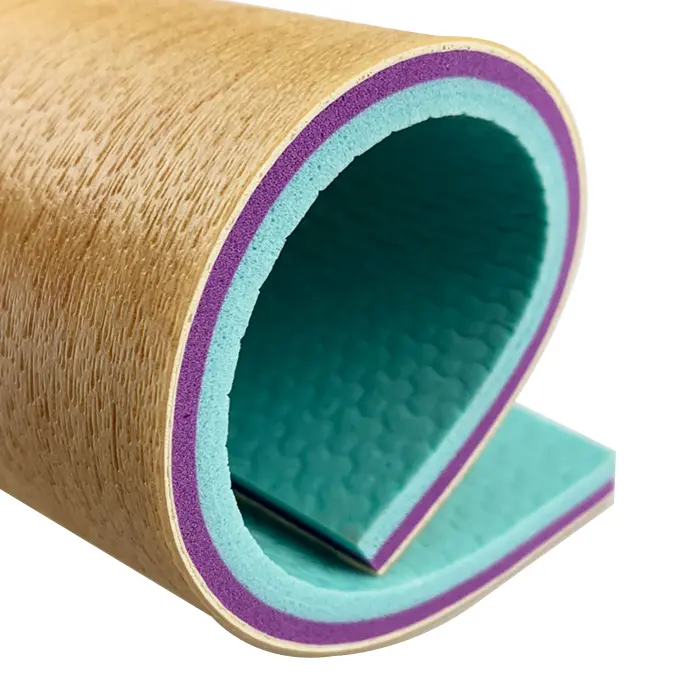
For vinyl flooring used in dance studios, you can usually choose between two structures: a harder one and a softer one with a foam layer for better cushioning.
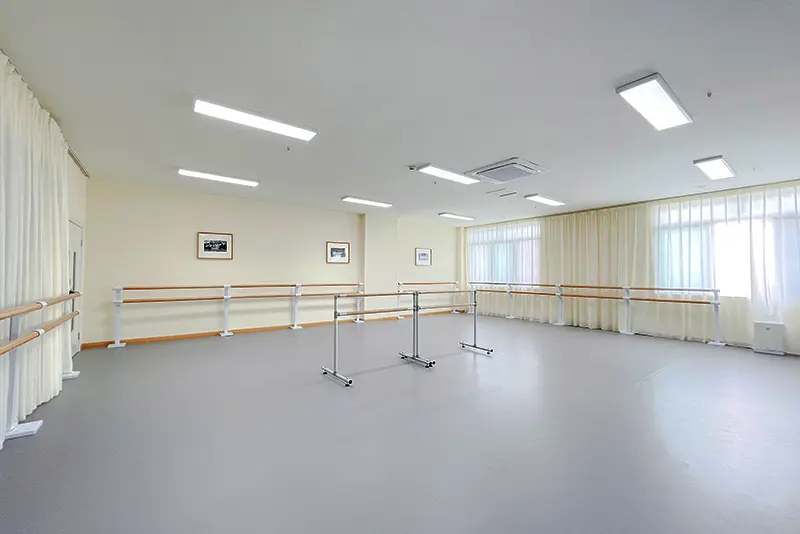
Both have their advantages and disadvantages. For example, the harder type is more wear-resistant and suitable for high-frequency use. The type with a cushioning foam layer provides better cushioning, but the force exertion is limited. The choice between these two structures can be made based on different dance styles.
The advantage of this PVC material is its flexibility; it can be cut to any length and width to fit dance studios of different shapes and sizes. Floor colors can also be chosen to match the style. Common colors are typically sophisticated gray, black, and off-white.
In summary, both wood flooring and vinyl commercial flooring have their advantages. Besides considering usage and performance, cost should also be taken into account. A balance of professionalism and practicality is important, or a combination of both can be considered.

Leave Your Message
Message us for free samples and quotes!