Stable commitment to every leap, customized every flat
Blog


Suning County, Cangzhou City, Hebei Province, China
16630207375
dxfloor144@gmail.com

Stable commitment to every leap, customized every flat
Blog
Garages are the core area for parking and storage in homes, businesses, and other locations. The floor easily accumulates stains such as oil, dust, and tire tracks, and neglecting to clean it can damage the floor. Cleaning requires choosing different methods based on the type of flooring material in your garage to achieve the best and fastest results.
Interlocked garage floor tiles are a common flooring material. Because of their hydrophobic, perforated structure, special attention should be paid to cleaning the grout lines and hard-to-reach areas of each tile.
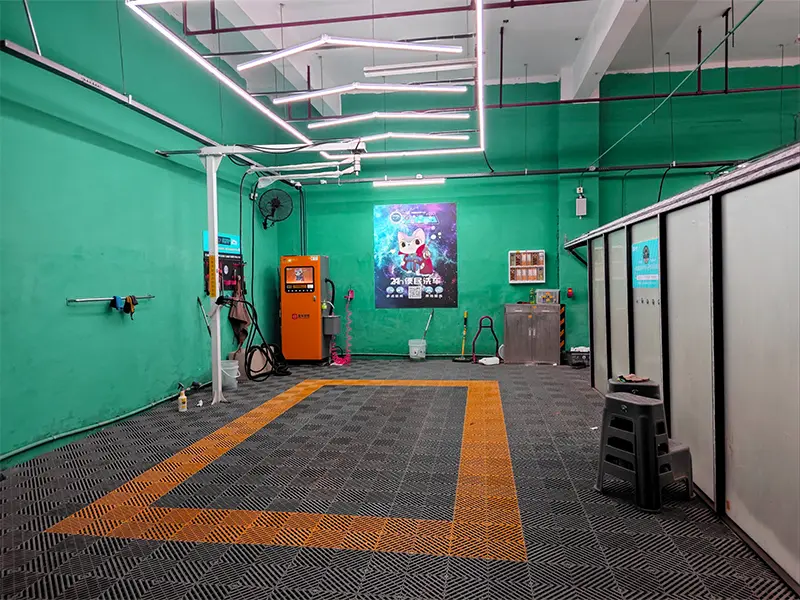
Prepare a high-pressure water gun, neutral detergent, soft-bristled brush, and absorbent mop.
First, use a high-pressure water gun to rinse the floor. Because this type of floor drains very quickly, simple stains are easily removed with frequent rinsing, making it difficult for stubborn oil stains and other dirt to remain on the surface. The water pressure also helps to quickly remove surface grime.
For stubborn stains that are difficult to clean, after rinsing with a high-pressure water gun, use a neutral detergent and a soft-bristled brush to scrub the affected areas. Then wait for a certain amount of time to allow the detergent sufficient time to dissolve the stains, and then rinse thoroughly again with a high-pressure water gun.
The advantage of using interlocking floor tiles is that if a particular stain is very difficult to clean, you can manually remove it for individual cleaning and then reassemble it. This is more convenient than other flooring materials, and damaged tiles can be replaced at any time, avoiding the cost of replacing the entire floor.
If your garage floor needs renovation or upgrades, our DXCK series of interlocking garage tiles is ideal. It comes in different colors, can withstand the loads of SUVs and off-road vehicles, and can be used reliably for a long time.
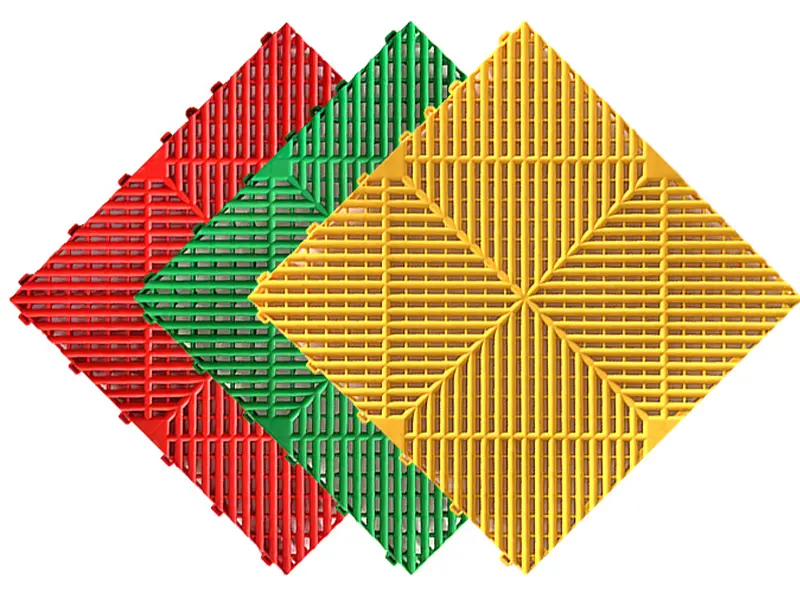
Learn about our garage floor tiles!
Avoid using strong acid or alkaline cleaners to prevent corrosion of the tile surface and cement.
Keep the high-pressure water gun at least 30cm away from the ground to avoid damaging the tile interlocking joints due to high pressure.
Epoxy flooring is a popular choice for garages and parking lots due to its wear resistance and ease of maintenance. The key to cleaning is "gentle care" to avoid damaging the coating.
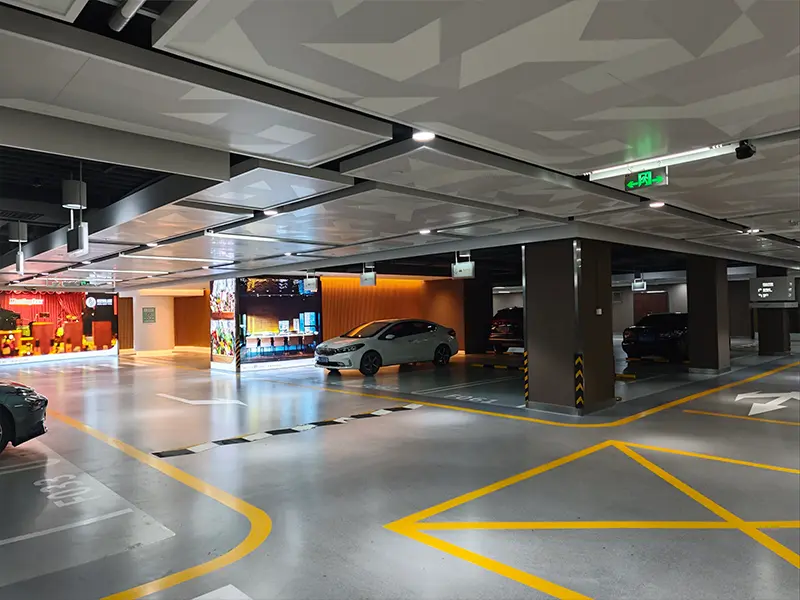
Tools: Soft-bristled broom, microfiber mop, neutral detergent (such as epoxy floor cleaner, diluted dish soap), plastic scraper (for stubborn stains), warm water.
Pre-treatment: Gently sweep with a soft-bristled broom to avoid scratching the epoxy coating with hard bristles; for adhering debris (such as chewing gum), gently scrape it off with a plastic scraper.
Daily dusting: Clean surface dust daily with a soft-bristled broom or vacuum cleaner (on soft brush mode) to reduce particle friction and damage to the coating.
Deep cleaning: 1-2 times per week. Dilute neutral detergent with warm water, apply to the microfiber mop, and wipe the floor evenly. For stubborn stains, press repeatedly with the mop; no vigorous scrubbing is required.
Rinse and Dry: Wipe away any residual cleaning agent with a clean water mop. Ventilate the room by opening windows or use a dry mop to absorb excess water, avoiding prolonged water accumulation (to prevent coating peeling).
Oil Stains: Immediately absorb surface oil stains with paper towels, then spray with an epoxy-specific degreaser. Let it sit for 10 minutes, then wipe with a mop and rinse with clean water.
Scratches: Minor scratches can be treated with epoxy repair agent; deep scratches require professional touch-up.
Do not use corrosive cleaning agents such as strong acids, strong alkalis, or acetone, as these will cause discoloration and peeling of the coating.
Avoid using steel wool, hard-bristled brushes, or other sharp tools to prevent scratching the floor.
Epoxy Flooring: Easy to clean, requiring only daily dusting and occasional wiping. No dirt can accumulate in grout lines, but corrosion and scratches must be avoided.
Interlocking brick flooring: Moderate cleaning difficulty; dust easily accumulates in the grout lines, requiring regular scrubbing; highly stain-resistant, stains do not easily penetrate.
Sealed concrete flooring: Easy cleaning; smooth surface after sealing; stains are easy to wipe away; cost between epoxy and interlocking brick, suitable for families with a moderate budget.
PVC garage flooring: Extremely easy cleaning; can be wiped directly with water without leaving residue; however, avoid scratching with sharp objects; suitable for users who prioritize easy cleaning.
Garage floor stains are mainly oil stains, rust, tire marks, and cement stains. Targeted treatment is necessary for efficient stain removal without damaging the floor:
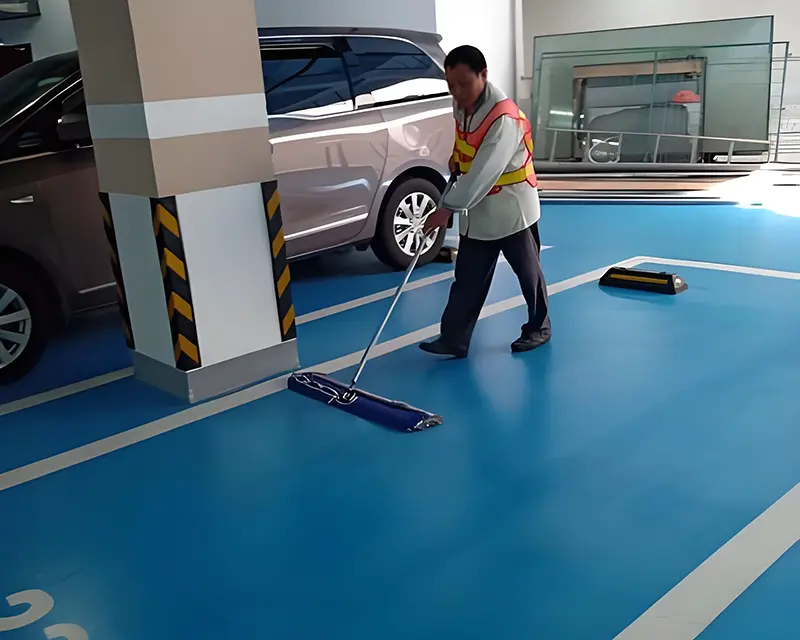
Tools: Paper towels, oil-absorbing mat, neutral degreaser, baking soda (for emergencies). Cleaning Steps: 1. **Oil Stains Removal Method:** First, blot the surface oil with paper towels/oil-absorbing mats (to prevent spreading). Sprinkle baking soda over the oil stains and let it sit for 30 minutes to absorb the grease. After sweeping, spray with an oil remover, gently scrub with a soft brush, and rinse with clean water.
Suitable for: All floor materials (epoxy flooring requires a special oil remover).
Tools: Citric acid solution (1:10 diluted), white vinegar, soft-bristled brush.
Cleaning Steps: Apply citric acid solution or white vinegar to the rust stains, let it sit for 15 minutes, gently scrub with a soft-bristled brush, repeat 2-3 times, and then rinse with clean water.
Note: For epoxy flooring, test on a corner first to avoid corrosion of the coating.
Tools: Alcohol, epoxy flooring tire remover, microfiber cloth.
Removal Steps: 1. Tire Marks Removal Method: Use a microfiber cloth dampened with alcohol or tire mark remover to repeatedly wipe the tire marks until they disappear. Then wipe away any residue with clean water.
Suitable Floors: Epoxy flooring, PVC flooring (Tire marks on interlocking brick floors can be directly scrubbed with a stiff-bristled brush and cleaning agent).
Tools: Cement mortar cleaner (weak acidic), plastic scraper, soft-bristled brush.
Removal Steps: Spray the cleaner onto the cement stain, let it sit for 20 minutes to soften the stain, then gently scrape it off with a plastic scraper. Clean any remaining stain with a soft-bristled brush and rinse with clean water.
Note: Interlocking brick floors can be cleaned directly. For epoxy flooring, control the cleaning agent's contact time to avoid corrosion.
To avoid increasing cleaning costs and spending excessive time and tools, it is recommended to clean the garage floor regularly. This will prevent stubborn stains from remaining for a long time and also serves as a form of floor maintenance, extending the floor's lifespan.


Leave Your Message
Message us for free samples and quotes!