Stable commitment to every leap, customized every flat
Blog


Suning County, Cangzhou City, Hebei Province, China
16630207375
dxfloor144@gmail.com
Stable commitment to every leap, customized every flat
Blog
In sports such as basketball, badminton, and pickleball, the slip resistance of the flooring is directly related to the safety and performance of athletes. There are certain differences in the slip resistance of traditional wooden sports floors and modern PVC sports floors. While classic, wooden floors are susceptible to slipping due to wear and moisture, while PVC plastic floors can also pose safety risks if their performance is insufficient. This issue stems from feedback and discussions from sports enthusiasts using their flooring. Therefore, as a manufacturer of PVC sports flooring, we have compared the two materials and explained the standard requirements for friction performance.
Wooden sports flooring (mostly maple or oak) was once the "standard" for professional venues, but it has inherent limitations in terms of slip resistance:
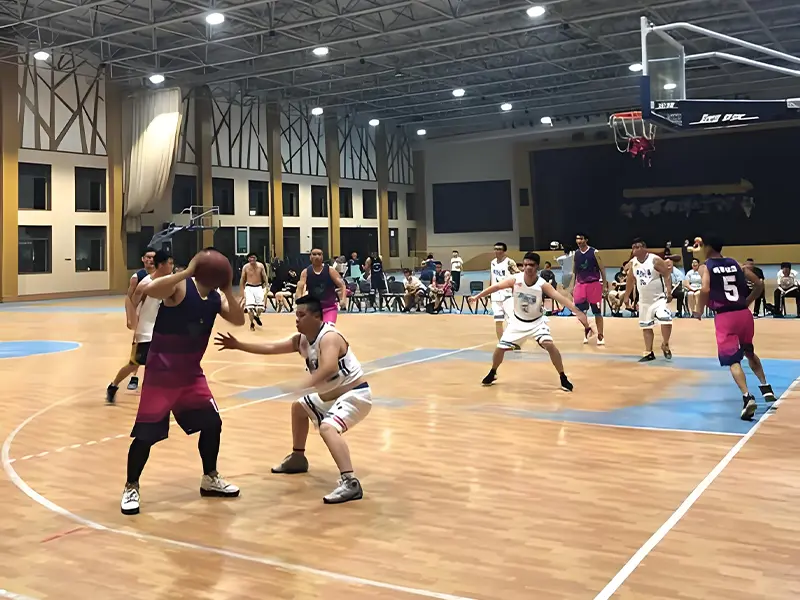
The slip resistance of wooden flooring relies on the natural wood grain or the texture created by later application of paint. However, athletes' frequent sudden stops and changes of direction can quickly wear out the texture. The wooden floors of professional basketball stadiums require a re-polishing of the anti-slip coating every one to two years on average. Otherwise, they can easily slip in humid environments (e.g., when athletes sweat or after cleaning). A player from a CBA team reported, "After the wooden floors wore out at the end of the season, the friction between the soles of my shoes and the floor was significantly reduced when changing direction, and I had to deliberately slow down every time I tried to break through."
Wooden floors are highly hygroscopic. If humidity in the venue is not properly controlled (e.g., during the rainy season), a "water film" easily forms on the surface, causing the coefficient of friction (COF) to drop sharply from 0.6 when dry to below 0.3 (EN 14411 standard). In this situation, athletes are at high risk of losing their balance during starts and sudden stops, which can affect their performance at best, or even lead to ankle sprains and knee strains at worst.
To maintain anti-slip performance, wooden floors require regular (quarterly) waxing and polishing. Each maintenance period requires the venue to be closed for 2-3 days. Furthermore, long-term use can lead to irreversible wear of the wood fibers, necessitating complete replacement. For example, for a 1,000 square meter basketball arena, the annual anti-slip maintenance cost for wooden floors can reach 50,000 to 80,000 yuan.
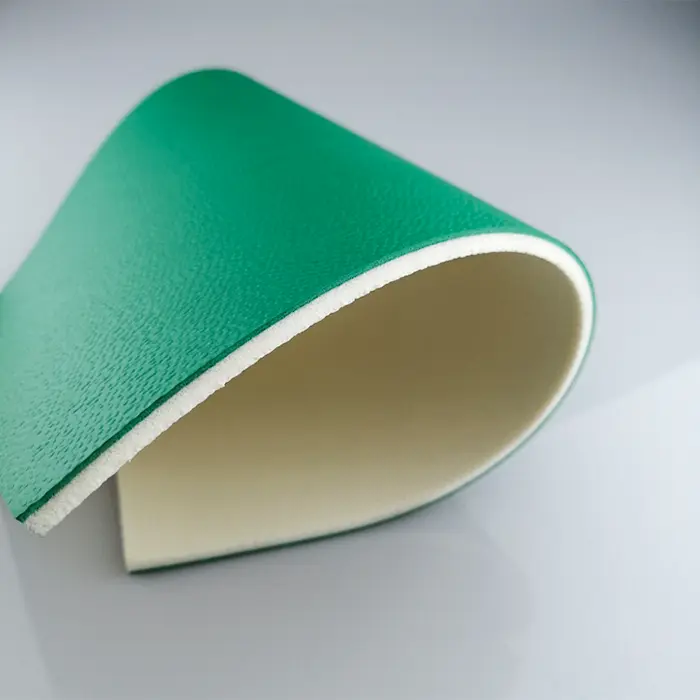
PVC vinyl flooring surpasses wooden flooring in anti-slip performance through optimized material formulation, surface texture, and structural design. Shengbang' sports flooring series offers differentiated solutions tailored to the anti-slip needs of various sports venues.
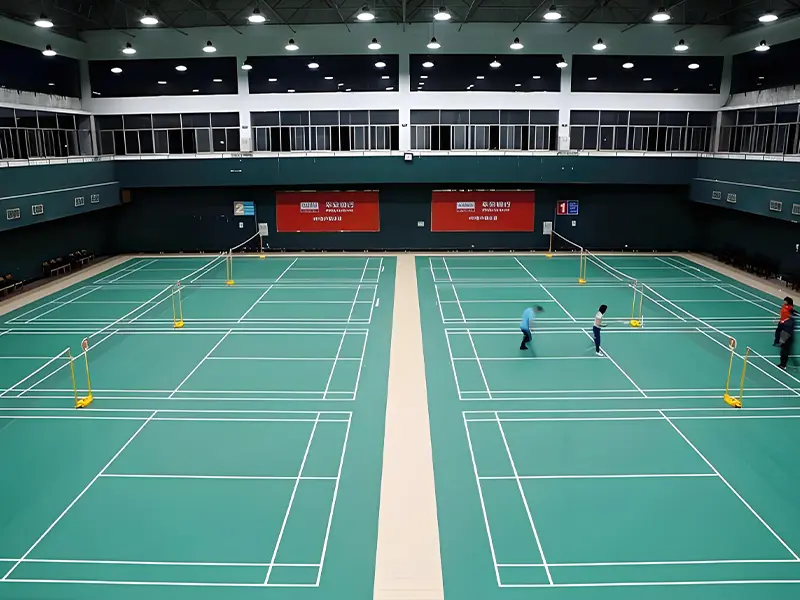
Dongxing Plastics uses a dual molding and UV curing process to create a wear-resistant layer on the surface of PVC flooring:
For high-intensity sports like basketball and volleyball, we use wood-like oak and maple patterns with a grain depth of 0.3-0.5mm. The dry coefficient of friction (COF) is ≥ 0.7, and the wet COF (simulating athlete sweat) is ≥ 0.6 (EN 14411 R10 grade), ensuring grip during sudden stops and changes of direction.
For sports that require frequent starts, such as badminton and table tennis, we use a crystal sand pattern (available in coarse and fine sand). This finer grain ensures anti-slip performance (COF ≥ 0.65) while maintaining the smooth gliding properties of sneakers.
These patterns are permanently fixed to the floor surface using UV curing technology. After more than five years of use, the grain wear rate is less than 10%, far superior to the wear characteristics of wood flooring.
Moisture-Insensitive: Even in high humidity environments exceeding 80%, the floor surface will not form a water film due to moisture absorption, and the coefficient of friction fluctuates ≤0.05.
Temperature Stability: Within the temperature range of -10°C to 40°C, the material hardness varies by less than 5 Shore A, ensuring that anti-slip performance is unaffected by temperature fluctuations (wooden floors are susceptible to thermal expansion and contraction, which can lead to increased cracks and grain deformation).
Stain and Slip Resistance: The dense PVC surface structure resists the penetration of sports drinks and sweat. Daily cleaning requires only a neutral detergent, and unlike wooden floors, the anti-slip performance will not be reduced by stain accumulation.
Dongxing Plastics' high-end series utilizes a "double-layer glass fiber + anti-slip base" construction:
The glass fiber layer ensures dimensional stability and prevents localized slippage caused by deformation.
Anti-slip particles are added to the base layer, providing "double anti-slip protection." Even if the surface texture is damaged by extreme wear and tear, the base layer's anti-slip performance still maintains basic safety requirements.
Use a soft-bristled broom or vacuum cleaner (no hard brushes) to remove dust from the surface to prevent particles from abrading the surface.
Use a diluted neutral detergent (such as a 1:100 ratio of dishwashing liquid to water) to remove stains. Avoid using strong acids or bases (which can corrode the PVC surface and reduce the coefficient of friction).
After cleaning, thoroughly dry with a dry cloth, especially in high humidity environments, to prevent residual moisture from causing "false slip."
Monthly, inspect the surface texture for wear. If local wear exceeds 30%, reapply a special anti-slip repair agent (containing nano-anti-slip particles). Once dry, the coefficient of friction can be restored to over 90% of its original value.
Quarterly, test the anti-slip performance of key areas (such as the three-point line and under the net) using a professional coefficient of friction tester (such as a COF tester) to ensure a COF of ≥0.6 (dry) and ≥0.55 (wet).
For sports areas near swimming pools, non-slip mats can be laid on top of the PVC floor (matching the floor texture to prevent excessive friction).
During winter snowy weather, shoe cleaners should be installed at venue entrances to prevent ice and snow from entering the venue and causing slippery floors.
In short, PVC sports flooring is more commonly used in various ball courts, while wooden sports flooring is more commonly used in basketball courts. A combination of the two can achieve even better results. Regardless of the flooring system chosen, ensure that its friction performance, resilience, and other aspects meet international standards to avoid compromising the user experience.

Leave Your Message
Message us for free samples and quotes!