Stable commitment to every leap, customized every flat
Blog


Suning County, Cangzhou City, Hebei Province, China
16630207375
dxfloor144@gmail.com
Stable commitment to every leap, customized every flat
Blog
ITTF certification assesses table tennis floor mats based on key pain points in indoor table tennis experience. Each indicator directly impacts player movement, shot execution, and safety. As a globally recognized authoritative standard in table tennis, ITTF certification requires products to pass tests on multiple indicators, including coefficient of friction, elastic recovery, abrasion resistance, and environmental safety. In formal training venues, over 92% use ITTF-certified mats; while on non-certified mats, players experience a 35% increase in shot errors due to surface issues and a 28% increase in the risk of joint discomfort during sharp turns.
Players frequently perform actions such as sudden stops, side slides, and crossover steps. Precise control of the surface friction coefficient is crucial. Too high a coefficient of friction results in excessive resistance during movement, leading to slow starts and muscle fatigue; too low a coefficient of friction causes slippage during sudden stops, affecting shot timing and potentially causing ankle sprains.
The dry coefficient of friction for table tennis mats needs to be controlled between 0.60 and 0.70. The surface texture increases the contact area between the sole and the ground, providing uniform friction.
See our ITTF Approved Table Tennis Flooring:
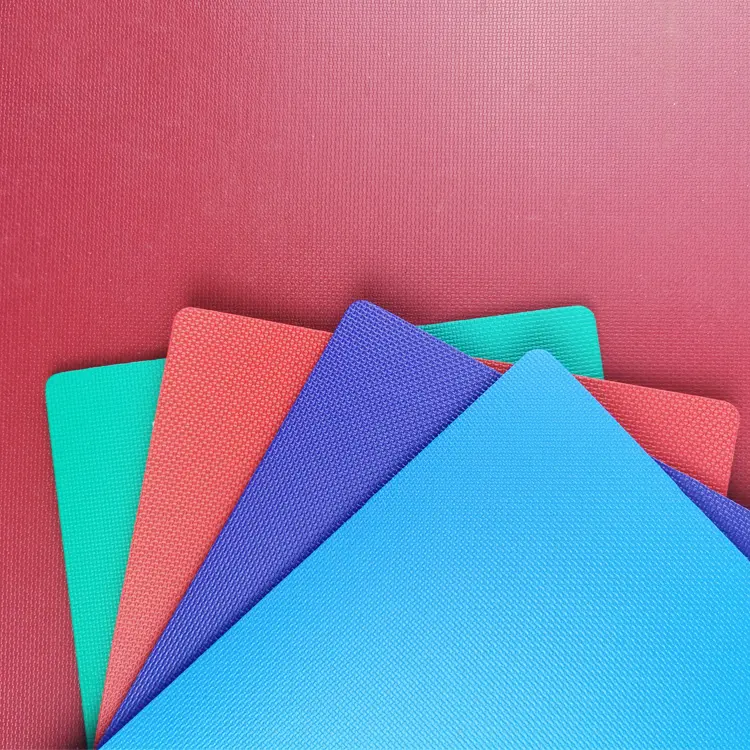
Although indoor table tennis is less intense than basketball or tennis, players maintain a low center of gravity for extended periods, and the ground reaction force during sudden stops and turns still exerts continuous impact on the knees and ankles. ITTF certification has specific requirements for the elasticity of table tennis mats: the ball rebound rate must be controlled between 85% and 90% (based on the rebound height of a standard table tennis ball dropped from a height of 1.5m), and the shock absorption rate must be ≥25%. This standard ensures both precise feedback during impact and effective absorption of joint impact.
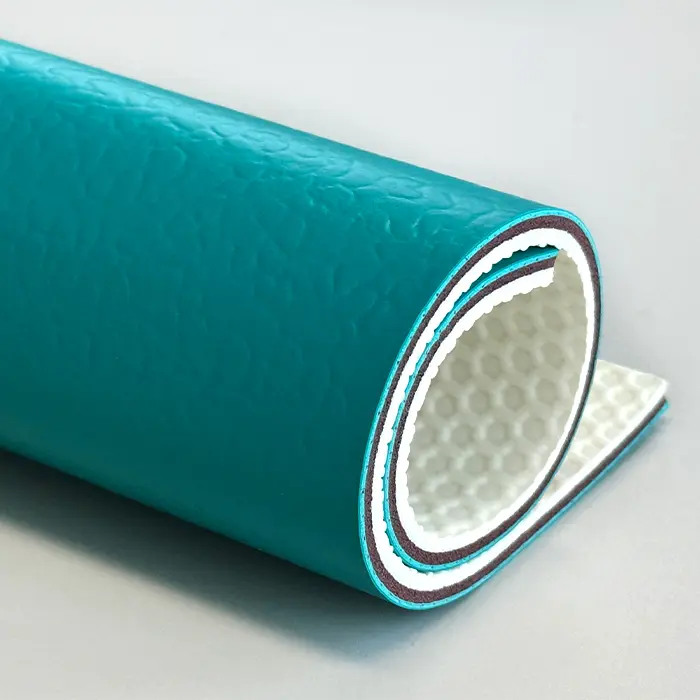
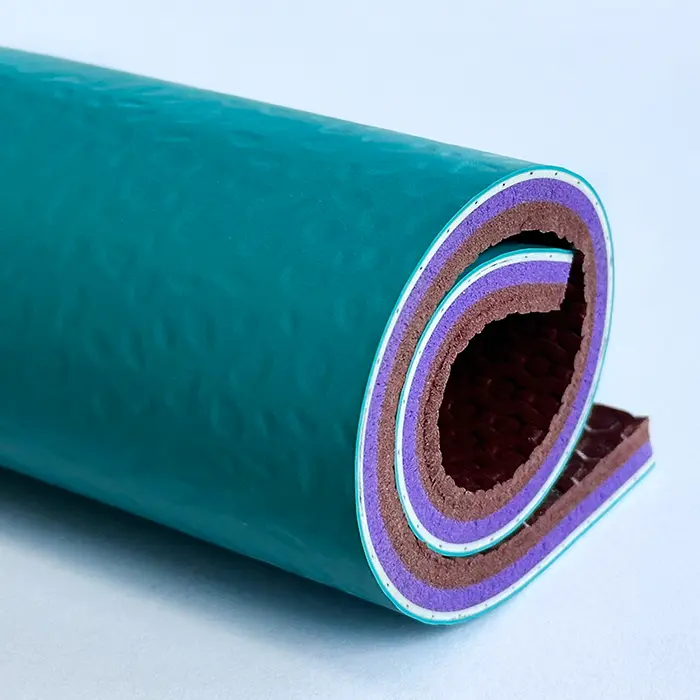
Our vinyl flooring rolls feature a 0.3-0.7mm thick PUR abrasion-resistant layer to guarantee a stable coefficient of friction; the bottom layer is a 2.0-4.0mm thick high-density foam elastic layer, achieving a balance between elastic recovery and impact absorption through precise control of the foam pore size (0.1-0.3mm).
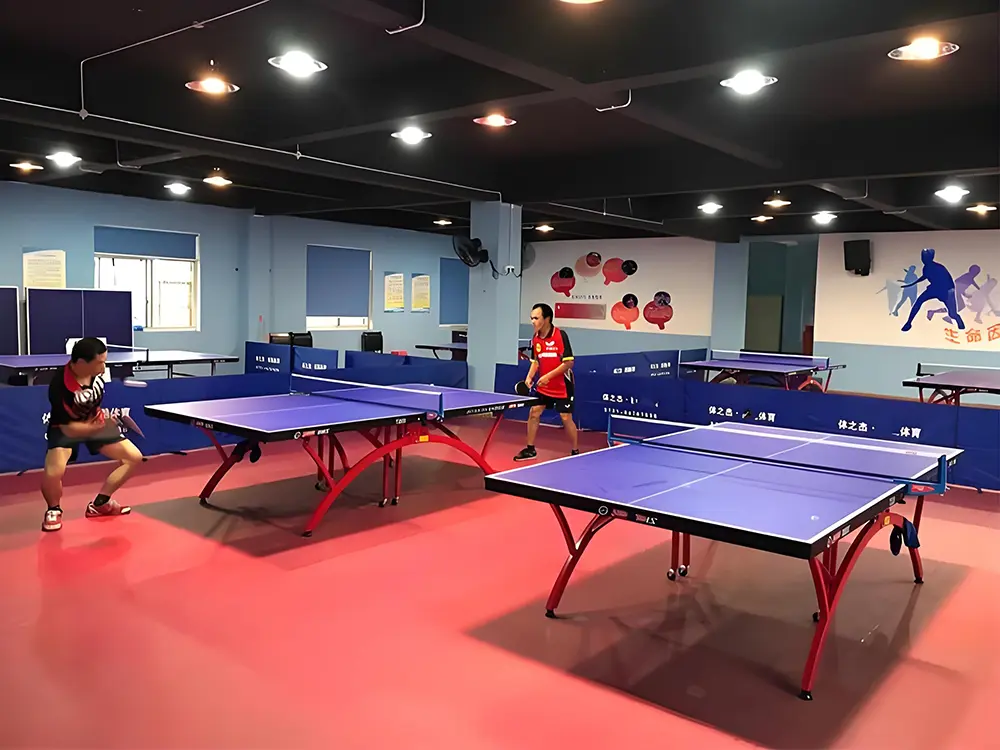
Temperature changes in indoor courts (air conditioning, seasonal changes) can cause the flooring to expand and contract. Poor dimensional stability can lead to problems such as edge warping, shrinkage, and unevenness at seams, affecting not only movement safety but also altering the surface flatness and causing abnormal ball bounce trajectories.
ITTF certification requires that the dimensional change rate of the table tennis flooring be ≤0.5% (after 24 hours of constant temperature at 60℃), and the Taber abrasion test abrasion amount be ≤0.1g/1000 revolutions. High-quality ITTF-certified flooring effectively suppresses thermal expansion and contraction through the addition of a double-layer fiberglass stabilizing layer.
For indoor table tennis courts, the core value of table tennis floor mats lies in "ensuring player experience and safety," and ITTF certification is the authoritative endorsement of this value. Choosing ITTF-certified mats not only provides precise friction control, stable elastic feedback, and excellent dimensional stability, but also effectively protects players' joints and improves athletic endurance and shot accuracy.
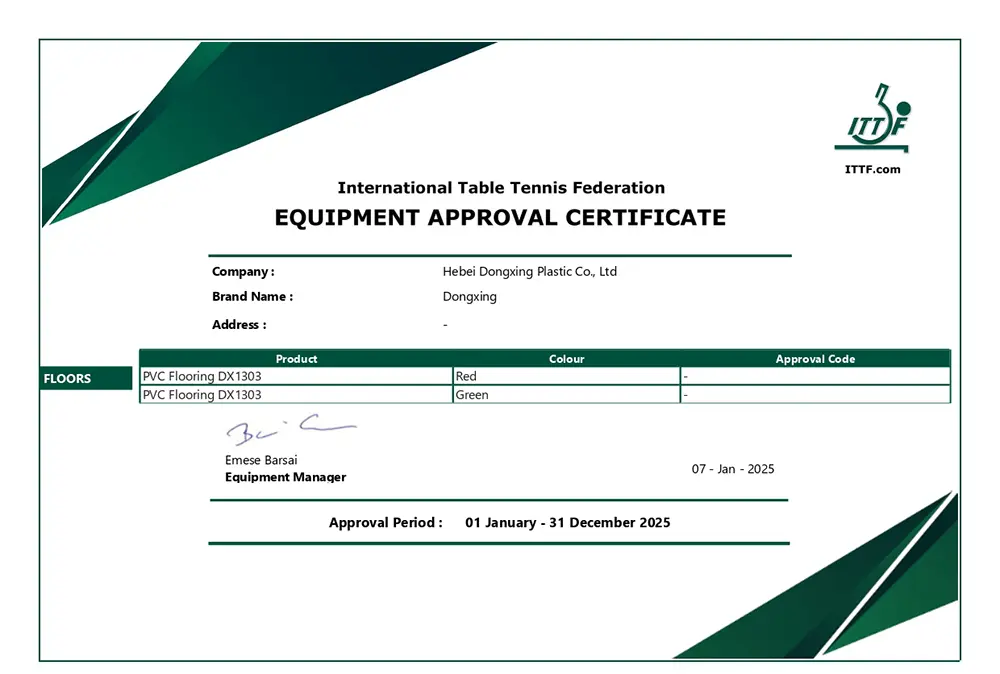
Dongxing (shengbang) ITTF Certificate:

Leave Your Message
Message us for free samples and quotes!